
By 3 PM, your neck feels tight. Your shoulders are up near your ears. You rub the back of your neck, and it feels like a rock.
You did not lift anything heavy today. You just sat and typed. So why does it hurt like this?
The answer is not your chair. It is not even your posture in the way most people think about posture. The real problem is a small set of muscles at the front of your neck called the deep neck flexors. They are weak, and they have been getting weaker every day you work from a laptop.
This guide shows you what these muscles do, how to test if yours are weak, and the exact exercises that fix them. No fluff. No filler stretches that feel nice but do nothing.
Why Your Neck Hurts by the End of the Workday
Your head weighs about ten to twelve pounds when it sits right on top of your spine. That is normal. Your neck is built to hold that weight all day without effort.
But when you lean toward a screen, your head moves forward. The muscles at the back of your neck and shoulders have to work harder to hold your head up. They get tired. They get tight. That tightness is the ache you feel by the afternoon.
This is not rare. Remote workers report neck pain more often than office workers, and the gap has grown since more people started working from kitchen tables and couches instead of proper desks, according to research tracked by Stealth Agents. If your neck hurts after a day of calls and typing, you are not the exception. You are the norm.
The good news is this is fixable. Not with a better chair alone. With stronger muscles at the front of your neck.
What Are the Deep Neck Flexors?
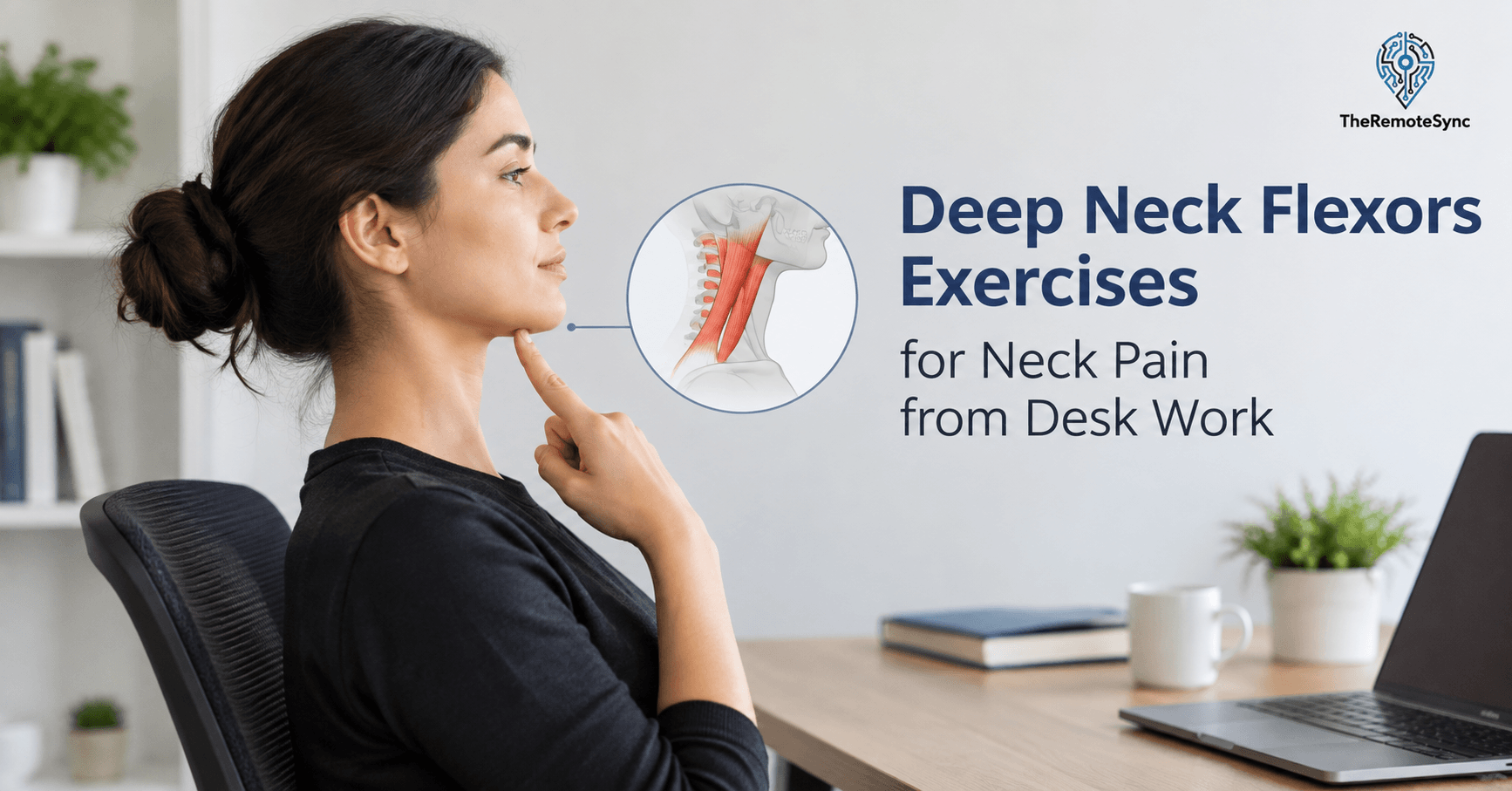
The deep neck flexors are a small group of muscles that sit deep in the front of your neck, close to your spine. You cannot see them or feel them easily, which is part of why they get ignored.
Their job is to hold your head in a straight line above your shoulders. Think of them as the muscles that keep your head from drifting forward.
Deep Neck Flexors Anatomy
The two main muscles in this group are the longus colli and longus capitis. Longus colli runs along the front of your neck bones. Longus capitis sits a bit higher and connects the base of your skull to your upper neck.
Two smaller muscles, rectus capitis anterior and rectus capitis lateralis, help out near the top of the neck. Together, this group is sometimes called the deep cervical flexors.
Deep Neck Flexors Function
These muscles do two main jobs.
- They pull your chin toward your chest. This is the motion you use when you nod or look down gently.
- They hold your neck bones steady. This is the more important job. They stop your head from wobbling or drifting forward during normal movement.
When these muscles are strong, your head stays balanced over your spine without much effort from any other muscle group.
Deep Neck Flexors and Extensors: The Balance That Breaks Down
Your neck has two opposing muscle teams. The deep neck flexors sit in front. The neck extensors sit in back, running from your skull down through your upper back.
In a healthy neck, these two teams share the load. The flexors hold your head steady from the front. The extensors hold it steady from the back.
Desk work breaks this balance. Hours of looking at a screen weaken the front muscles and overwork the back ones. Your extensors get tight and sore because they are doing a job that used to be shared. Your flexors get weak because they barely get used.
This is why stretching your neck alone rarely fixes anything. Stretching the tight back muscles gives short relief, but the front muscles stay weak. The imbalance comes right back the next day at your desk.
Signs of Weak Deep Neck Flexors
Most people never connect their neck pain to weak front-of-neck muscles. Here are the signs to check for.
- Your chin juts forward when you sit. Look at yourself in a mirror or a video call screenshot. If your ears sit in front of your shoulders instead of above them, this is forward head posture.
- Neck pain shows up by mid-afternoon. Pain that builds through the day, especially after long stretches of screen work, points to muscle fatigue rather than injury.
- Tension headaches at the base of your skull. Tight neck extensors, working overtime because the flexors are not helping, often refer pain up into the head.
- Your neck tires quickly when you hold your head up. If lying down and lifting your head feels hard within a few seconds, that is a direct sign of flexor weakness.
- Rounded shoulders that do not fix with reminders. Weak deep neck flexors often show up alongside a forward-rounded upper back, since the two postural problems feed each other.
If two or more of these sound familiar, your deep neck flexors are very likely part of the problem.
Why Are My Deep Neck Flexors Weak?
Muscles get weak the same way they get strong. Use builds them up. Disuse lets them fade.
Here is what causes that disuse for most remote workers.
- Laptop screens sit too low. Looking down at a laptop for hours trains your head to sit forward instead of upright.
- Long, unbroken sitting blocks. Remote work often means fewer natural breaks than an office job, where walking to a meeting room or a colleague’s desk used to interrupt sitting time.
- No dedicated workspace. Working from a couch, bed, or dining chair puts your neck in a worse position than a proper desk setup.
- Hybrid work switching. Bouncing between a home setup and an office setup, or between a proper desk and a coffee shop table, means your neck rarely gets a consistent, correct position.
- Video calls. Staring at your own face or a grid of coworkers for hours adds up to more forward head time than most people realize.
None of this is about willpower. It is about the shape of remote and hybrid work itself. Your WFH setup is training your neck muscles every single day, whether you notice it or not.
The Deep Neck Flexor Endurance Test
Before jumping into exercises, it helps to know where you stand. This test gives you a real answer instead of a guess.
How to run it:
- Lie on your back on a firm surface, like a yoga mat or the floor.
- Tuck your chin slightly, like you are nodding “yes” in a small motion.
- Lift your head about one inch off the floor, keeping the chin tuck.
- Hold this position and time yourself.
- Stop the timer the moment your chin lifts, your head shakes, or you feel your neck muscles give out.
A hold under ten seconds points to real weakness in your deep neck flexors. This version of the test has been studied for its reliability as a simple clinical check, according to research published in the Journal of Manipulative and Physiological Therapeutics.
Do not push through pain. A little muscle shake is normal. Sharp pain is not, and means you should stop and check with a doctor or physical therapist before continuing.
Write your time down. Retest every two to four weeks. That number is your proof that the exercises below are working.
How to Strengthen Deep Neck Flexors, Step by Step
This is the part that actually fixes the problem. These exercises target the deep neck flexors directly, the same way you would train any other weak muscle.
Chin Tuck (Start Here)
This is the single best deep neck flexor exercise, and the easiest to get wrong. Most people pull their head straight back instead of tucking the chin, which works the wrong muscles.
- Sit or stand tall, with your ears over your shoulders.
- Without tilting your head up or down, glide your chin straight back, like you are making a double chin.
- You should feel a gentle pull at the base of your skull, not in your throat or jaw.
- Hold for five seconds.
- Release slowly.
- Repeat 10 times.
Do this three times a day. It sounds small. It is not. This single motion is the foundation for every deep neck flexor exercise that follows.
Chin Tuck Against Resistance
Once the basic chin tuck feels easy, add resistance.
- Sit tall and place two fingers on your chin.
- Perform the chin tuck, but gently press back against your fingers as you go.
- Hold the position for five seconds while keeping light pressure.
- Release.
- Repeat 10 times.
This small amount of resistance builds real strength faster than the unloaded version alone.
Supine Head Lift (Progression)
This exercise builds directly on the endurance test above, and it is the most effective deep neck flexor activation exercise once your neck is ready for it.
- Lie on your back with your knees bent, feet flat on the floor.
- Tuck your chin gently.
- Lift your head about one inch off the floor.
- Hold for five to ten seconds.
- Lower slowly.
- Repeat 8 to 10 times.
Only add this exercise once the basic chin tuck feels comfortable and pain-free. If your neck shakes badly or you feel strain in your throat, go back to the basic chin tuck for another week first.
How Often and How Long
- Chin tucks: three sets of 10, spread through the day, every day.
- Chin tuck against resistance: once the basic version feels easy, usually after one to two weeks.
- Supine head lift: two to three times a week, once you can hold a basic chin tuck for 10 seconds without strain.
Most people notice less end-of-day tension within two to three weeks. Real postural change, the kind you can see in a photo, takes six to eight weeks of consistent work.
How to Strengthen Deep Neck Flexors at a Desk
You do not need to lie on the floor mid-meeting to work on this. These versions fit into a normal remote work day.
- Seated chin tuck between calls. Do 10 reps right before you join a video call. Nobody will notice, and it takes fifteen seconds.
- Chin tuck while reading. Any time you glance down at your phone, tuck your chin first. This trains the correct habit during the exact motion that usually causes the problem.
- Standing wall chin tuck. Stand with your back against a wall, heels a few inches out. Try to flatten the back of your head toward the wall using a chin tuck. This gives you instant feedback on whether you are doing the motion correctly.
- Micro breaks every 45 minutes. Set a timer. Stand, tuck your chin, roll your shoulders back twice. This breaks the forward head pattern before it locks in for the day.
These desk versions will not replace the floor exercises entirely, but they keep your neck engaged through the hours where the damage actually happens.
How Long Does It Take to Fix Forward Head Posture?
Most people want a number, so here is an honest one. Expect four to eight weeks of consistent daily work before you see a real change in how your head sits.
The first two weeks usually bring less end-of-day soreness. That is your nervous system getting better at activating the right muscles, not new muscle size yet.
Weeks three through six are where actual strength builds. This is when people start noticing they catch themselves sitting straighter without thinking about it.
By week eight, most people with mild to moderate forward head posture see a visible difference in photos and video calls. More severe cases, or posture problems built up over many years, can take longer. Consistency matters more than intensity here. Ten minutes a day for two months beats one hard session a week.
Can Weak Neck Flexors Cause Headaches?
Yes. This is one of the most overlooked connections in desk-related pain.
When your deep neck flexors are weak, your neck extensors and upper trapezius muscles take over the job of holding your head up. These muscles were not built for that job long-term. They get tight and develop trigger points, especially near the base of the skull.
That tension refers pain upward, often felt as a dull ache behind the eyes or a tight band around the head. This is commonly called a tension headache, and it is one of the most common headache types in people who work at screens all day.
Strengthening the deep neck flexors takes pressure off the overworked back muscles, which is often enough to reduce how often these headaches show up.
Fixing Your WFH Setup So the Exercises Actually Stick
Exercises alone can be undone by a bad setup. If your workspace keeps pulling your head forward, you are fighting your own daily routine.
Monitor and Laptop Height
The top of your screen should sit at or just below eye level. If you work from a laptop without a stand, you are almost certainly looking down for hours, which cancels out a lot of the progress from your exercises.
A basic laptop stand paired with an external keyboard and mouse fixes this fast. This is one of the highest-value changes a remote worker can make, and it costs far less than ongoing physical therapy visits.
Chair and Sitting Habits
The best chair for forward head posture is not about brand or price. It is about whether it supports your lower back well enough that you are not sliding forward and craning your neck to see your screen.
Look for a chair with real lumbar support and armrests at a height where your shoulders can relax. If your current chair forces you to slouch within twenty minutes, no amount of neck exercise will fully offset that.
Take Breaks Between Meetings
Hybrid work often means back-to-back calls with no walk to a different room in between. Build in short breaks on purpose. Even ninety seconds of standing and moving your neck through its full range breaks the static forward-head position before it becomes locked in.
Do You Need a Posture Corrector or Neck Pillow?
Remote workers often ask about gear like posture correctors, cervical pillows, and neck traction devices. Here is the honest answer.
Posture correctors that physically pull your shoulders back can help you notice bad posture, but they do not build muscle. Wearing one without doing the exercises above is like wearing a knee brace instead of strengthening your legs. It manages the symptom, not the cause.
A cervical pillow, one shaped to support the natural curve of your neck, can genuinely help if your neck pain is worse in the morning. Poor sleep positioning adds to the same forward head pattern you are fighting during the day.
Neck traction devices, which gently stretch the neck while you lie down, can offer short-term relief for tight extensor muscles. They do not strengthen the deep neck flexors, so they work best as a complement to the exercises above, not a replacement for them.
If you are choosing between spending money on gear or spending ten minutes a day on chin tucks, start with the free option. Add gear once the muscle work is already part of your routine.
How to Release Tight Neck Muscles and Deep Cervical Fascia
Fascia is the thin connective layer that wraps around your neck muscles. When you sit hunched for hours, this tissue can feel stiff and stuck, not just the muscle underneath it.
Here are safe ways to release it at home.
- Gentle self massage on the sides of your neck. Use light pressure with your fingertips along the sides of your neck, avoiding the front center where major blood vessels sit.
- Warm compress before stretching. Heat makes tight fascia more pliable. Apply a warm towel for five to ten minutes before doing neck stretches.
- Slow neck rotations. Gently turn your head side to side and tilt ear to shoulder, holding each position for a few seconds rather than bouncing through the motion.
- Upper back foam rolling. Since neck fascia connects into the upper back, rolling out your thoracic spine often reduces neck tightness as a side effect.
One important caution. Do not apply deep pressure to the front of your neck. This area holds your carotid artery and other sensitive structures. Deep or aggressive pressure here is a job for a trained massage therapist or physical therapist, not a self-treatment session.
Could a Vitamin Deficiency Be Making Your Neck Tighter?
Sometimes tight muscles are not only about posture. Certain nutrient shortages make muscles cramp and stay tense more easily.
Magnesium is the most common one to check. Low magnesium makes it harder for muscles to fully relax after they contract, which can leave your neck feeling tight even after stretching. Foods like leafy greens, nuts, and whole grains are good sources.
Vitamin D deficiency has also been linked to general muscle pain and tightness, including in the neck and shoulders. Since remote work often means less time outdoors during daylight hours, this is worth paying attention to.
This is not a reason to skip the exercises above. Nutrient gaps make muscle tightness worse, they do not cause weak deep neck flexors on their own. If your neck stays tight despite regular exercise and a decent setup, a simple blood test from your doctor can rule out a deficiency as a contributing factor.
Frequently Asked Questions
What are the deep neck flexors?
A group of small muscles at the front of your neck, including the longus colli and longus capitis, that hold your head balanced above your spine.
How do I strengthen deep neck flexors?
Start with basic chin tucks, three sets of 10 daily. Progress to chin tucks against light resistance, then to supine head lifts once the basic version feels easy and pain-free.
What are the symptoms of weak deep neck flexors?
Forward-jutting chin, afternoon neck pain, tension headaches at the base of the skull, a neck that tires quickly, and rounded shoulders that do not improve with posture reminders.
How to release deep cervical fascia?
Gentle self-massage on the sides of the neck, warm compress before stretching, slow neck rotations, and upper back foam rolling. Avoid deep pressure on the front of the neck.
What vitamin deficiency causes tight neck muscles?
Low magnesium and low vitamin D are both linked to muscle tightness and cramping, including in the neck. A blood test can confirm either.
How do you activate deep neck flexors?
The chin tuck motion, gliding your chin straight back without tilting your head up or down, is the primary activation exercise for these muscles.
Why are my deep neck flexors weak?
Hours of looking down at laptop screens, long unbroken sitting blocks, working from non-desk setups, and inconsistent hybrid work environments all train these muscles to stay underused.
What causes forward head posture?
Prolonged screen time with a low monitor or laptop, weak deep neck flexors, tight chest and upper trapezius muscles, and long hours without postural breaks.
How long does it take to fix forward head posture?
Expect four to eight weeks of consistent daily exercise for a visible change. Less soreness often shows up within the first two weeks.
Can weak neck flexors cause headaches?
Yes. Weak deep neck flexors force the neck extensor and upper trapezius muscles to overwork, which commonly refers pain up into tension headaches.
Start Today, Not After Your Next Neck Pain Flare-Up
Pick one thing from this article and do it before you close this tab. Set a timer for 45 minutes and do 10 chin tucks when it goes off. Do that every workday for the next two weeks, then run the endurance test again and compare your time.
That single habit, done consistently, will do more for your neck than any pillow, chair, or posture corrector on its own.