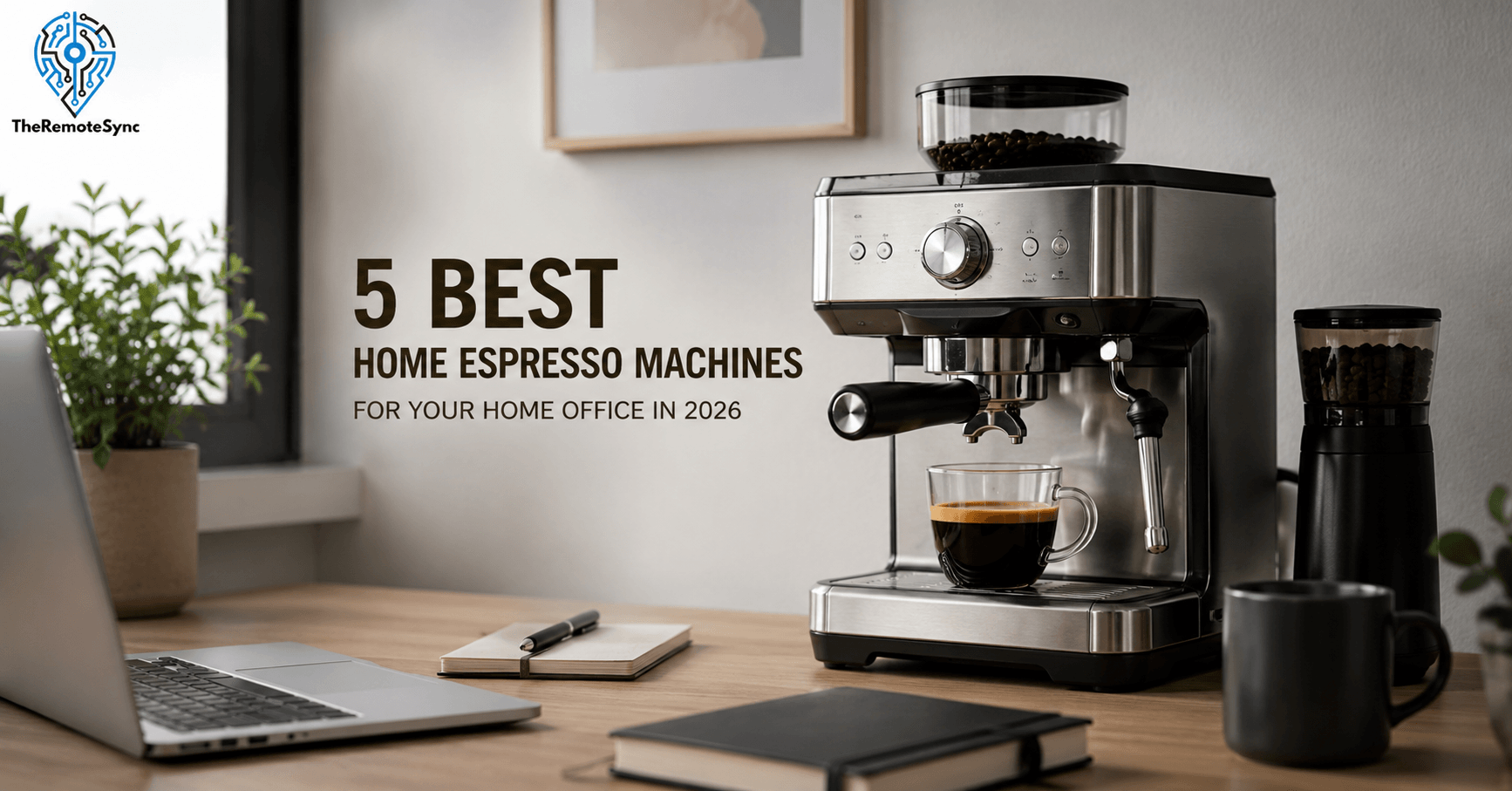
Your 10 am meeting just ended. Your 10:15 starts in five minutes. You need coffee, but the nearest cafe is a ten-minute round trip you don’t have. This is the daily math that pushes a lot of remote workers toward buying their own espresso machine.
The good news is that home espresso has gotten a lot better and a lot easier over the past few years. You do not need a $2,000 machine or a barista certificate to make something that beats what you’d pay $6 for at a coffee shop. You do need to pick the right machine for your space, your budget, and how much you actually want to learn.
This guide covers five best home espresso machines that consistently show up at the top of buyer guides in 2026, and that are all available on Amazon. Each one is built for a different kind of home office setup, from a tiny desk corner to a full kitchen counter you can dedicate to your coffee routine.
If you’re building out a whole home office, not just a coffee corner, our guide on remote work ergonomics and setup basics covers the rest of the space.
Quick Comparison
| Machine | Best for | Typical price | Standout feature |
| Breville Bambino Plus | Fast mornings in a tiny footprint | $400 to $500 | Heats up in about 3 seconds |
| Gaggia Classic Evo Pro | Learning real espresso skills | $450 to $500 | Commercial 58mm portafilter |
| De’Longhi Dedica Maestro Plus | Small kitchens that still want automatic milk | $350 to $400 | Auto LatteArt steam wand |
| Breville Barista Express Impress | One machine that grinds, doses, and tamps for you | $650 to $780 | Assisted tamping with a dosing gauge |
| De’Longhi La Specialista Arte Evo | Hot espresso and cold brew from one machine | $650 to $700 | Cold Extraction Technology |
A quick note before you scroll further: almost every honest review of these machines lands on the same point. The grinder matters as much as the machine. A $500 espresso machine paired with stale, pre-ground coffee will taste worse than a $200 machine paired with fresh beans and a good grinder. Keep that in mind as you read the picks below.
Breville Bambino Plus, best for a small desk setup and fast mornings
Who this is for
The Bambino Plus is built for someone who wants espresso fast and does not want to fuss with dials or manuals. If your home office coffee routine has to fit between calls, this is the machine that respects your time.
It is Breville’s narrowest espresso machine, at under 8 inches wide, so it fits on a shelf or a small counter without taking over the space. The brushed stainless steel body looks clean next to a laptop stand or a monitor arm, which matters if your desk and your kitchen counter are the same surface.
Under the hood, the Bambino Plus uses Breville’s ThermoJet heating system. Instead of waiting 20 to 40 seconds like older machines, it reaches brewing temperature in about 3 seconds. A built-in PID controller keeps that temperature steady through the whole shot, and the machine also handles milk automatically, offering three froth textures and three temperature settings so you do not have to learn manual steaming technique.
What customers actually say
Buyers who use this machine daily consistently mention how much time the fast heat-up saves on busy mornings, especially compared to older boiler machines that need a warm-up routine. One detailed independent review noted that the pre-infusion and 54mm portafilter work together to reduce channeling, meaning shots came out consistent almost every time during testing.
On the critical side, several reviewers flag that the machine is sensitive to exact coffee dose. If you eyeball your grounds instead of weighing them, you’ll get inconsistent shots. A few buyers also mentioned the milk frother can overflow if you fill the pitcher too high, especially when making larger drinks like a big latte.
Pros
- The ThermoJet heating system gets the machine to brewing temperature in about 3 seconds, so there is almost no wait between deciding you want coffee and pulling your first shot.
- Automatic milk texturing removes the biggest learning curve in home espresso, letting you make a decent latte or cappuccino on day one without practicing steaming technique.
- The 54mm portafilter and built-in pre-infusion work together to produce consistent shots without much manual adjustment.
- At under 8 inches wide, it is one of the smallest full-featured espresso machines on the market, which matters if your kitchen counter doubles as your desk.
- The 2-year warranty and Breville’s reputation for parts availability make long-term ownership less risky than with newer, smaller brands.
Cons
- There is no built-in grinder, so you will need to budget separately for a decent burr grinder if you want fresh, consistent grounds.
- The pressurized double-wall baskets that come standard are forgiving but cap how good your espresso can taste compared to non-pressurized baskets paired with a quality grinder.
- Some buyers report the milk frother can overflow during larger pours, so you will need to watch your milk level closely at first.
Price context
At $400 to $500, the Bambino Plus sits in the middle of the home espresso market. It costs more than bare-bones machines like the De’Longhi Dedica Style, but you’re paying for genuine PID temperature control and automatic milk texturing, features that used to only appear on machines costing twice as much. If your budget allows for one $500 purchase and you want the least fussy path to good espresso, this is a strong place to spend it.
Gaggia Classic Evo Pro, best for learning real espresso skills
Who this is for
The Gaggia Classic Evo Pro is for the person who wants to actually learn espresso, not just drink it. There is no PID, no automatic anything, and no built-in grinder. You control the pump, the steam, and the timing yourself. For some remote workers, that hands-on ritual is part of what makes the coffee break worth taking.
Made in Italy, the Evo Pro uses a commercial-grade 58mm portafilter, the same size used in actual coffee shops. That means it works with a huge range of aftermarket baskets, bottomless portafilters, and accessories if you want to upgrade later. The updated model includes a 3-way solenoid valve, which relieves pressure after brewing so your used coffee puck comes out dry and easy to knock out, and an overpressure valve tuned to the correct 9 bar extraction pressure recommended by the Specialty Coffee Association.
What customers actually say
Long-term owners frequently mention that the machine is built to last, with some reporting more than a decade of daily use with only minor part replacements. Reviewers also praise how moddable it is. Spending around $250 on upgrades like a PID kit can turn this into a machine that performs close to units costing several times more.
On the downside, multiple reviews mention the lack of a PID means temperature can drift slightly between shots, which matters more if you’re using lighter roast beans. Others note the single boiler forces you to wait between pulling a shot and steaming milk, since the same boiler handles both jobs. A few users also mention the switches feel dated compared to the digital displays on newer machines.
Pros
- The commercial 58mm portafilter gives you access to the same accessory ecosystem used in actual cafes, so you can upgrade baskets, tampers, and portafilters as your skills grow.
- Owners regularly report machines lasting 10 to 15 years with basic maintenance, which spreads the cost out over a very long ownership period.
- The updated overpressure valve now delivers a proper 9 bar extraction out of the box, correcting a common complaint from earlier Gaggia Classic models.
- A large online community of Gaggia Classic owners means troubleshooting help, mod guides, and replacement parts are easy to find.
- The all-metal housing and internals feel noticeably sturdier than most machines under $500.
Cons
- There is no PID temperature control, so shot-to-shot temperature consistency depends more on your technique and timing than on the machine itself.
- The single boiler means you cannot brew and steam milk at the same time, which slows down back-to-back drink making.
- There is a real learning curve here. If you want a machine that does the thinking for you, this is not it.
Price context
At $450 to $500, the Evo Pro costs about the same as the Bambino Plus, but you are paying for different things. Instead of automation, you’re paying for commercial-grade parts and a machine built to be repaired and upgraded rather than replaced. If you already know you enjoy the process of dialing in a shot, or you want a machine that can grow with you for a decade, this is the better value of the two.
De’Longhi Dedica Maestro Plus, best for small kitchens that still want automatic milk
Who this is for
The Dedica Maestro Plus is built for home offices where counter space is the real constraint, not budget. It keeps the slim profile that made the original Dedica line popular, while adding an automatic steam wand so you are not stuck learning manual milk texturing in a cramped kitchen.
The machine runs on a 15 bar pump and a thermoblock heating system, ready to brew in under a minute from a cold start. A control panel on top lets you choose from three espresso temperatures and three milk foam settings, which is more temperature control than most machines offer at this price. The automatic steam wand, which De’Longhi calls Auto LatteArt, handles milk frothing with the press of a button, though it works best with dairy and oat milk rather than more delicate alternatives.
What customers actually say
Reviewers who tested this daily for over a month consistently praise the simple, clearly labeled controls, noting that programming shot volume or switching temperature settings is easy to figure out without digging through the manual. Several also point out that the pressurized baskets included in the box make it forgiving for first-time users, while the included non-pressurized baskets give more experienced users room to improve their shots later.
The most common complaint across reviews is noise. Both the vibration pump and the automatic steam wand are noticeably loud, which several testers said was disruptive in a quiet morning kitchen. A few reviewers also mention the 51mm portafilter is smaller than the more common 54mm and 58mm sizes, which limits your options if you want to buy aftermarket baskets later.
Pros
- The automatic steam wand removes the need to learn manual milk texturing, which is especially useful in a tight kitchen where you can’t stand at the machine practicing technique.
- Three adjustable brew temperatures let you fine-tune extraction for lighter or darker roasts, a feature rarely found on machines in this price range.
- The compact footprint fits on narrow counters, making it one of the better options if your home office coffee station has to share space with everything else in your kitchen.
- Programmable shot volumes mean the machine remembers your preferred pour size, so you don’t have to eyeball it every morning.
- Both pressurized and non-pressurized baskets are included, giving you room to grow into better technique without buying separate parts.
Cons
- The machine runs loud, both while pumping and while steaming milk, which can be a real downside if you’re making coffee early while others are still asleep.
- The 51mm portafilter is a less common size, so your choices for upgraded baskets and bottomless portafilters are more limited than with 54mm or 58mm machines.
- The 1.6 liter water tank is on the smaller side, meaning more frequent refills if you’re making multiple drinks a day.
Price context
At $350 to $400, the Dedica Maestro Plus is one of the more affordable machines on this list that still includes automatic milk frothing. It costs less than the Bambino Plus while offering similar convenience features, though it trades some of that savings for a smaller portafilter size and a noisier steam wand. For remote workers whose main constraint is counter space rather than budget, it is a smart middle ground.
Breville Barista Express Impress, best for one machine that grinds, doses, and tamps for you
Who this is for
The Barista Express Impress is for someone who wants the full espresso experience, grinding, dosing, tamping, and brewing, without buying and managing four separate pieces of equipment. It is the machine most buying guides point to as the best all-in-one option in 2026, and it’s a strong pick if you want a single purchase to cover your whole home office coffee setup.
The machine includes a built-in conical burr grinder with 25 grind settings, so you can dial in the right texture for different beans. Its standout feature is the Impress Puck System, which applies a calibrated 22 pounds of tamping pressure automatically and gives you a feedback gauge showing whether your dose is correct, underfilled, or overfilled. A PID-controlled thermocoil keeps brewing temperature steady, and the whole system is built around Breville’s 54mm commercial-style portafilter.
What customers actually say
One long-term reviewer who tested it for several weeks alongside older Breville and competitor machines wrote that the automated tamping and dosing removed the two biggest points of failure for home baristas: uneven dosing and inconsistent tamp pressure. Buyers on retail review sections mention that the built-in grinder noticeably improves flavor over pre-ground coffee, and that the guided workflow made it approachable even for total beginners.
The most common criticism is the price. At $650 to $780, it costs significantly more than most machines on this list, and a few reviewers note that the assisted tamping system locks you into 22 pounds of pressure with no manual override, which limits experimentation for people who want full control over every variable. Others mention the single steam wand hole makes back-to-back milk drinks slower than machines with more powerful steam output.
Pros
- The Impress Puck System automates tamping and dosing, which are the two steps most likely to go wrong for beginners, so your shots are consistent from the very first day.
- A built-in 25-setting conical burr grinder means you are working with freshly ground coffee every time, without needing a separate grinder taking up more counter space.
- The dosing feedback gauge shows you in real time whether your grind is too much, too little, or just right, which speeds up the learning process significantly.
- PID temperature control and pre-infusion work together to produce stable, well-extracted shots without manual temperature management.
- Everything you need, including tamper, portafilter, and cleaning tools, is included in the box, so there is no separate equipment to track down.
Price context
At $650 to $780, this is the most expensive machine on this list, and it should be judged as an all-in-one system rather than compared directly to standalone espresso machines. When you account for the cost of buying a separate grinder to pair with a machine like the Bambino Plus or Gaggia Classic, the price gap narrows. If you want the fewest separate purchases and the smallest overall footprint for a complete setup, this justifies the higher price tag.
De’Longhi La Specialista Arte Evo, best for hot espresso and cold brew from one machine
Who this is for
The La Specialista Arte Evo is built for remote workers whose coffee needs change throughout the day, a hot espresso in the morning and a cold brew in the afternoon, without needing two separate machines cluttering the kitchen. It combines a built-in grinder, a commercial-style steam wand, and De’Longhi’s Cold Extraction Technology in one compact unit.
The integrated conical burr grinder offers 8 grind settings, dosed through a timed system rather than a precise digital dose, which means pairing it with a kitchen scale helps if you want repeatable results. Active Temperature Control lets you pick from three brewing temperatures to match different roast profiles, and the Cold Extraction Technology can produce a single-serve cold brew in under 5 minutes, a genuinely useful feature if iced coffee is part of your afternoon routine.
What customers actually say
Owners who use this daily for medium-light roasts describe the espresso as smooth and not overly acidic, and several specifically call out how easy the water tank is to remove and rinse compared to other machines they’ve owned. One reviewer who ranked it against several competitors called it the best money they had spent on kitchen equipment.
The recurring complaint is grind precision. Several buyers, including some in online coffee communities, mention needing a finer grind than the machine’s 8 settings allow for a proper 20 to 30 second extraction. A few also note that the small 8.8 ounce bean hopper needs frequent refilling if you’re making multiple drinks a day, and that removing the single-wall filter baskets from the portafilter can be fiddly.
Pros
- Cold Extraction Technology brews a full cold brew serving in under 5 minutes, which is genuinely rare among home espresso machines and useful if you drink iced coffee in the afternoon.
- The built-in grinder and steam wand mean you are not buying or storing separate equipment, which matters in a home office where counter space doubles as workspace.
- Active Temperature Control with three settings lets you adjust extraction temperature to match lighter or darker roasts.
- The compact footprint is one of the smallest among machines with a built-in grinder, fitting into kitchens where a full-size setup would not.
- Included barista tools, like a dosing guide and tamping mat, reduce mess while you’re still learning proper technique.
Cons
- The grinder’s 8 settings offer less range than dedicated grinders, and some users find it difficult to get fine enough for a proper espresso extraction with certain beans.
- The small bean hopper capacity means more frequent refilling compared to machines with larger hoppers.
- Removing the single-wall filter baskets from the portafilter can require extra effort, which is a small but repeated daily annoyance.
Price context
At $650 to $700, the Arte Evo sits close to the Barista Express Impress in price, but you’re paying for versatility rather than automation. If cold brew is a real part of your routine and not just a nice-to-have, this is the only machine on this list that gives you both formats without a second appliance. If you only drink hot espresso, the Barista Express Impress or Gaggia Classic Evo Pro will likely serve you better for the same money.
How to Choose Between These Machines
Decide How Much You Want to Learn Versus How Much You Want Automated
This is the single biggest factor buyers get wrong. If you want a machine that removes decisions, pick the Bambino Plus, the Dedica Maestro Plus, or the Barista Express Impress. If you want to actually develop espresso skills over time and don’t mind a learning curve, the Gaggia Classic Evo Pro rewards that investment. Buying a fully manual machine because it looks impressive, then getting frustrated with inconsistent shots, is one of the most common regrets in home espresso.
Budget for the Grinder, Not Just the Machine
If you choose a machine without a built-in grinder, like the Bambino Plus or the Gaggia Classic Evo Pro, plan to spend 30 to 40 percent of your total budget on a quality burr grinder. A $500 espresso machine paired with a $30 blade grinder will taste worse than a $250 machine paired with a $150 burr grinder. This single decision affects your coffee’s flavor more than almost anything else in your setup.
Measure Your Actual Counter Space Before You Buy
Espresso machines look smaller in product photos than they are in person. Before buying, measure the exact spot on your counter or desk where the machine will live, including clearance above it for filling the water tank and below it for the drip tray. The Dedica Maestro Plus and the Bambino Plus are the two narrowest options here, which matters if your kitchen and your home office share the same square footage.
Think About Noise if Your Workspace Is Nearby
If your desk sits close to your kitchen, machine noise matters more than most buying guides mention. Reviewers consistently flag the Dedica Maestro Plus as one of the louder options on this list, both during brewing and steaming. If you’re making coffee during a video call or while someone else is sleeping nearby, this is worth weighing against its space-saving benefits.
Frequently Asked Questions
Is it worth buying an espresso machine for home?
Yes, if you drink espresso drinks more than a few times a week. A daily coffee shop habit runs $1,200 or more a year. Most of the machines on this list pay for themselves within a year of daily use, and after that, every cup is nearly free. If you only want coffee once in a while, a cheaper drip machine or pour-over setup makes more sense.
How much should I spend on a home espresso machine?
Budget $400 to $700 for the machine itself, plus a separate grinder if the machine does not include one. Spending less than $300 usually means a plastic build and a pressurized basket that limits how good your espresso can taste. Spending more than $800 only makes sense if you want features like dual boilers or full manual pressure control.
Do you need a grinder for a home espresso machine?
Yes, unless you buy a machine with one built in, like the Barista Express Impress or the La Specialista Arte Evo. Pre-ground coffee loses freshness within days, and espresso needs a grind size finer than most grinders sold for drip coffee can produce. A decent burr grinder makes more difference to your final cup than upgrading the machine itself.
What is the best home espresso machine for beginners?
The Breville Bambino Plus is the easiest starting point. It handles temperature and milk texturing automatically, so you can focus on learning dose and grind size without juggling every variable at once. The Gaggia Classic Evo Pro is a better fit if you want to learn manual technique from day one.
How long do home espresso machines usually last?
A well-maintained machine in this price range should last 5 to 10 years, and some owners report Gaggia Classic models running for 15 years or more. Regular descaling and steam wand cleaning are the biggest factors in lifespan. Skipping maintenance is the most common reason machines fail early.
Get Your Coffee Sorted, Then Fix the Rest of Your Setup
Picking the right espresso machine solves one part of a home office. If your desk, chair, or monitor setup still needs work, that’s the next thing worth fixing. Check out our full guide to building a proper ergonomic home office setup, and start with whichever part of your day currently causes the most friction.