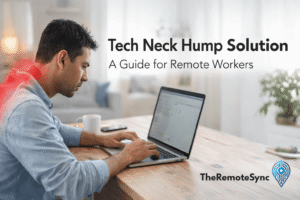

Most people figure out they have tech neck when the pain stops going away on its own. You stretch, you sleep it off, and it’s back by noon the next day. That’s usually when the question shifts from “why does my neck hurt?” to “is this actually fixable?”
The short answer to can tech neck be reversed: yes, in most cases. But the timeline and what you need to do depend on how far along it is. This article breaks that down practically, based on what the recovery process actually looks like for remote workers who spend six to ten hours a day at a screen.
What Tech Neck Is Actually Doing to Your Muscles
Tech neck isn’t just bad posture. It’s a muscle imbalance that builds up over months.
When your head tilts forward, the muscles in the back of your neck (your cervical extensors) have to work constantly just to hold it up. Over time, they become chronically tight and fatigued. Meanwhile, the deep neck flexors at the front — the muscles that are supposed to stabilize your head — stop firing properly because they’re barely being used.
The result is a neck that’s stuck in a losing tug-of-war. The tight muscles pull your head forward. The weak muscles can’t pull it back. And your upper back starts rounding to compensate.
This is why just “sitting up straighter” doesn’t fix it. Your brain forgets how to activate the right muscles. You need to retrain them.
According to research published in the journal Surgical Technology International, for every inch your head moves forward from neutral, the effective load on your cervical spine roughly doubles. At a typical “looking down at your phone” angle, that can be the equivalent of 40 to 60 pounds of force on your neck.
Is Tech Neck Reversible Or Does It Eventually Become Permanent?
For most remote workers, tech neck is a functional problem, not a structural one. That’s an important distinction.
A functional problem means your muscles and movement patterns have adapted to a poor position. That is reversible. A structural problem means the bones or discs themselves have changed, which takes years of neglect to develop.
If you’ve been dealing with neck stiffness and mild pain for months but haven’t yet developed numbness, tingling in your arms, or a visible forward curve that doesn’t correct when you stand up straight, you’re likely in functional territory. Consistent work over weeks to months can get you back to neutral.
If you’re already experiencing nerve-related symptoms or you have a visible tech neck hump that doesn’t flatten out at all when you actively correct your posture, that’s worth a visit to a physio before you start any exercise program. Some structural changes are still improvable, but you need a professional to assess the baseline.
How Long Does It Actually Take?
There’s no honest universal answer, but here are realistic ranges based on severity:
Mild (occasional stiffness, no visible changes): 2 to 4 weeks of consistent daily stretching and posture correction. You’ll notice the stiffness decreasing, especially in the mornings.
Moderate (frequent pain, noticeable forward head position, tension headaches): 6 to 12 weeks. You’ll need a combination of strengthening exercises, setup changes, and regular movement breaks. Progress isn’t linear, so expect some setbacks, especially on high-screen days.
Severe (visible hump, nerve symptoms, pain that radiates into the shoulders or arms): This can take 6 months or longer, and you’ll get further faster with physical therapy than with self-managed stretching alone.
The variable that matters most isn’t how long you’ve had tech neck. It’s how consistently you address it going forward.
The Four Things That Actually Drive Recovery
Generic advice says “stretch more and sit up straight.” That’s not wrong, but it’s not enough either. These are the four levers that actually move the needle.
1. Fix the Forward Head Position at the Source
You can stretch your neck three times a day and still make zero progress if you’re spending eight hours with your monitor too low. The ergonomic setup has to come first — otherwise you’re bailing water with a leaky bucket.
The practical fix:
- Monitor height: The top of your screen should sit at or just below eye level. If you’re on a laptop, you need a stand. Working off a flat laptop screen on a desk almost guarantees a forward head position.
- Screen distance: 20 to 28 inches from your face. Closer than that and you unconsciously lean in.
- Lumbar support: When your lower back is unsupported, your upper back rounds to compensate, which then pulls your head forward. A good chair for tech neck addresses this. A lumbar cushion also works if you can’t replace the chair.
If you’re working from a laptop without an external monitor most days, a laptop stand with an external keyboard is probably the single highest-impact change you can make.
2. Train the Deep Neck Flexors — Not Just Stretch the Tight Ones
Most people focus entirely on stretching the tight muscles (the back of the neck, the traps). That helps with pain but doesn’t fix the underlying imbalance.
The muscles that need to be strengthened are the deep neck flexors — small stabilizers at the front of your cervical spine that most people have essentially switched off.
The chin tuck is the most effective entry point. It’s not glamorous, but physical therapists consistently rely on it for good reason.
How to do it correctly:
- Sit or stand with your back straight.
- Without tilting your head up or down, draw your chin straight back — like you’re making a double chin.
- Hold for 5 seconds. Release slowly.
- Repeat 10 times, twice a day.
The key thing most people get wrong: they tilt their head down and then pull back, which is not the same movement. Your gaze should stay level the whole time.
For a full progression of exercises beyond the basic chin tuck, the tech neck exercises guide on this site walks through a structured routine you can do at your desk.
3. Open Up the Chest
Tech neck and a tight chest almost always come together. When you’re hunched over a screen, your pectoral muscles shorten and start pulling your shoulders forward, which reinforces the entire forward-head pattern.
Stretching the chest doesn’t just feel better — it physically makes it easier to maintain neutral posture without effort.
Doorway chest stretch: Stand in a doorway with your arms at 90 degrees on the frame. Step one foot forward and gently lean through the opening until you feel a stretch across the front of your chest. Hold 20 to 30 seconds. Do this twice a day.
It sounds simple, and it is. Most people who do it consistently are surprised by how tight they actually were.
4. Address Sleep Position
Eight hours of bad neck position at night can undo a day of good habits at the desk. Most people with tech neck are either sleeping on a pillow that’s too thick (keeping the head pushed forward) or on their stomach (which rotates the neck for hours at a time).
A supportive pillow for tech neck should keep your head in neutral, neither pushed up toward your shoulder nor dropped down toward the mattress. For back sleepers, a contoured cervical pillow often works well. For side sleepers, you want enough loft to fill the gap between your shoulder and your ear.
Stomach sleeping is genuinely hard on the neck and worth addressing if that’s your default. Most people can shift to a side position with a body pillow over a few weeks.
What About the Neck Lines?
Tech neck lines — the horizontal creases that form on the skin from constantly looking down — are a separate concern from the musculoskeletal issue, but they often come up together.
The honest answer: improving your posture slows down the formation of new lines and can reduce the depth of existing ones by reducing how often the skin is folded. But the skin component responds more slowly than the muscle component. If you’re looking for a faster improvement in how the skin looks, topical retinoids and consistent hydration are the evidence-backed options. Posture correction alone won’t be enough if the lines are already well established.
For a deeper look at the skin-specific side of this, the tech neck wrinkles article covers that in more detail.
How to Know If You’re Actually Making Progress
This is something most articles skip over. Recovery from tech neck is gradual and easy to miss day-to-day.
Signs you’re moving in the right direction:
- Morning stiffness is shorter or less intense
- You can hold a neutral head position for longer before fatigue sets in
- Tension headaches are decreasing in frequency
- Your chin tuck has become easier, and you can feel it activating different muscles than when you started
A practical check: look at yourself in a side-on photo or mirror. Your ear should be directly above your shoulder in a neutral stance. If it was noticeably forward before and it’s getting closer to aligned, that’s measurable progress.
If you’ve been consistent for 8 weeks and notice none of the above, that’s a signal to see a physiotherapist rather than just continuing with self-managed stretching.
When to Stop Self-Managing and See a Professional
Self-managed recovery works well for mild to moderate cases. But there are a few situations where professional assessment is the right call:
- Pain or numbness radiating down your arm or into your fingers
- Headaches that start at the base of your skull and don’t improve with stretching
- Visible asymmetry in your neck or shoulders
- Any improvement that plateaus completely after 6 to 8 weeks of consistent effort
A physiotherapist can do a hands-on assessment of which specific muscles are underperforming and build a program around your actual deficits — not a generic routine. That’s often the difference between making real progress and spinning your wheels.
Frequently Asked Questions
How to reverse text neck?
Focus on four things: fix your monitor height so your head isn’t tilting forward all day, train the deep neck flexors with chin tucks rather than just stretching the tight muscles, open up your chest with doorway stretches, and check your sleep position since a pillow that’s too thick undoes daytime progress overnight. Most mild to moderate cases improve within weeks when all four are addressed together.
How long will it take to fix a tech neck?
It depends on severity. Mild cases with occasional stiffness and no visible changes typically take 2 to 4 weeks of consistent work. Moderate cases with frequent pain and a noticeable forward head position take 6 to 12 weeks. Severe cases with a visible hump or nerve symptoms can take 6 months or longer and benefit from physical therapy rather than self-managed stretching alone.
Is it possible to get rid of tech neck hump?
Yes, in most cases, since the hump is usually a functional problem rather than a structural one. If it flattens out when you actively correct your posture, that’s a good sign it’s reversible with consistent work. If it doesn’t flatten at all even when you correct your posture, or comes with nerve symptoms, it’s worth having a physiotherapist assess it before starting an exercise program.
Is a tech neck a double chin?
No, they’re related but not the same thing. Tech neck is a musculoskeletal pattern involving forward head posture and muscle imbalance. A double chin appearance can result from that forward head position compressing the skin and soft tissue under the jaw, but it’s a visual side effect of the posture rather than tech neck itself.
What are the symptoms of tech neck?
Common symptoms include neck and upper back stiffness that builds through the day, tension headaches, a visible forward head position, and in more advanced cases a hump at the base of the neck or horizontal lines on the skin. Numbness or tingling radiating into the arms is a more serious sign that points toward nerve involvement and warrants a professional assessment.
The Realistic Expectation
Tech neck didn’t develop in a week, and it won’t reverse in one either. But it’s also not the kind of thing that requires a complete lifestyle overhaul to improve.
The people who make the most progress are typically doing three things: they fixed their monitor height, they do chin tucks daily, and they break up long sitting stretches with short movement. That combination, done consistently, is enough to see real change in most mild to moderate cases.
For a broader overview of how all the pieces fit together — setup, exercises, habits — the how to fix tech neck guide covers the full picture in one place.
Start with the monitor and the chin tuck. Those two things alone put you ahead of most people.