Your neck feels tight by 2 PM. Your shoulders drift up toward your ears. By the end of the day, you have a dull ache between your shoulder blades.
You stretch your neck. It feels better for ten minutes. Then the ache comes back.
If this sounds familiar, you are not alone. Many remote workers feel it, especially after months of working from a laptop at home. It rarely starts with one bad day. It starts with small habits that repeat all week.
The pattern behind it has a name: upper cross syndrome. It is common, and in most cases it can be improved. This guide shows you what causes it, how to check for it at home, and what to change in your daily habits and your WFH setup.
What Is Upper Cross Syndrome?
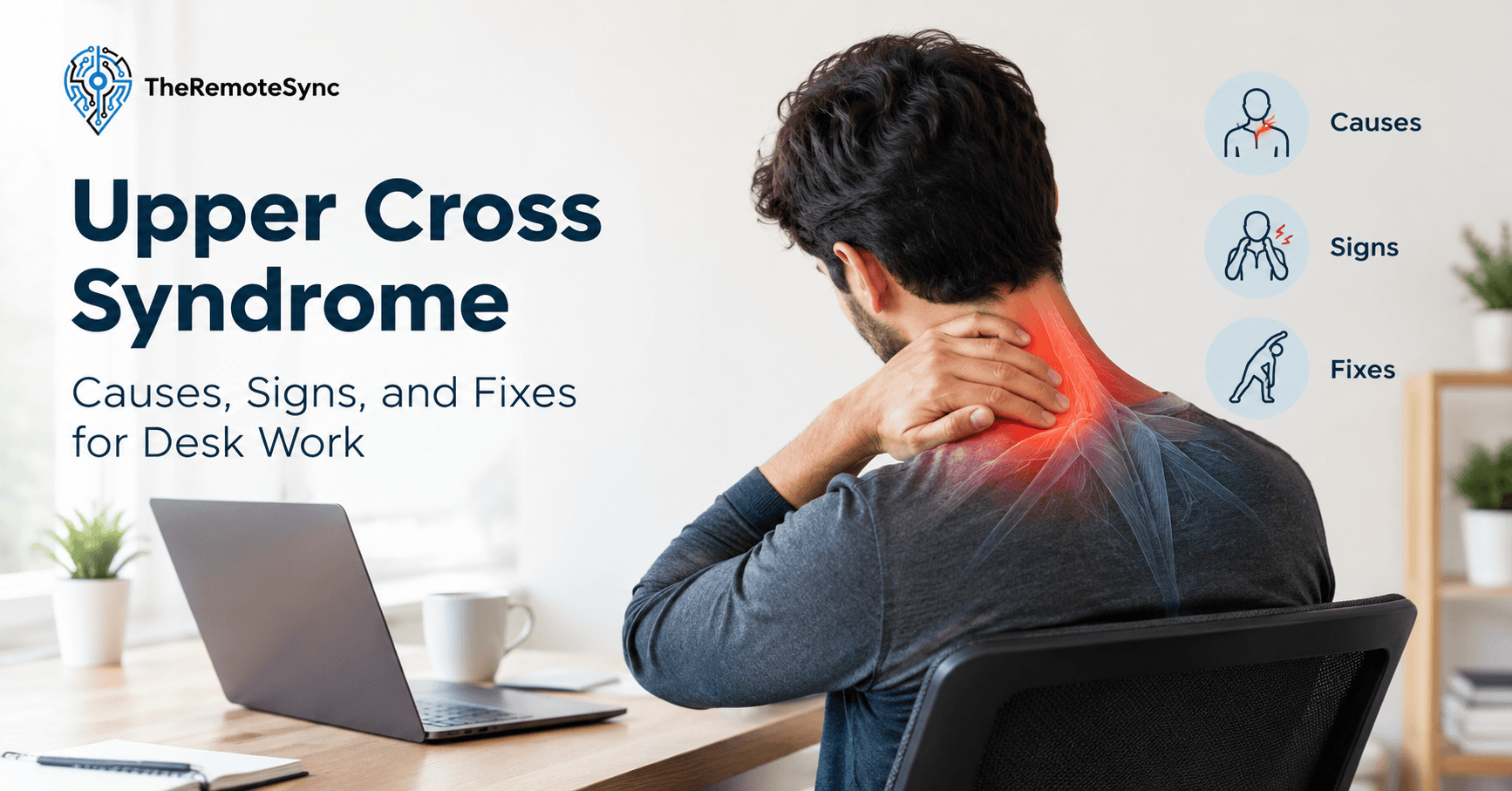
Upper cross syndrome (UCS) is a muscle imbalance in the neck, shoulders, and chest. Some muscles get tight and short. Others get weak and stretched. The imbalance pulls your head forward and rounds your shoulders. Long hours of sitting are the most common cause.
You may also see it called upper crossed syndrome or cervical crossed syndrome. They all describe the same pattern.
Why It Is Called A “Cross”
Picture an X drawn over your upper body. One line connects the tight muscles. The other line connects the weak ones. That X gives the condition its name.
Here is how the two lines break down:
| Group | Muscles involved | What you may feel |
| Tight and short | Chest muscles (pectorals), upper trapezius, levator scapulae (runs from the neck to the shoulder blade) | Pulling, tightness, a knot near the neck |
| Weak and stretched | Deep neck flexors (front of the neck), rhomboids, lower and middle trapezius (between and below the shoulder blades) | Tiredness, aching, trouble holding good posture |
What UCS Looks Like From the Outside
You will see a few terms online. Here is what each one means in plain words.
- Forward head posture: Your ears sit ahead of your shoulders instead of right above them.
- Rounded shoulders: Your shoulders roll forward and in, toward your chest.
- Hunchback posture (hyperkyphosis): Your upper back curves more than it should.
- Scapular winging: The edge of a shoulder blade sticks out from your back.
You do not need all four. Many people have only one or two.
Why Stretching Alone Rarely Works
Most people go after the tight spot. They stretch the neck. They roll a ball on the shoulder. It helps for a while.
But tight muscles are often working overtime. They are covering for weak muscles that should be holding your head and shoulders in place. If you only stretch, the weak muscles stay weak. The tightness comes back.
That is why a good fix has two sides. Loosen what is tight. Build what is weak. You will see this again in the fix section.
What Causes Upper Cross Syndrome in Remote Workers?
Posture problems rarely come from one big mistake. They come from the same small position, held for hours, day after day.
Remote work makes this easy. Nobody checks your setup. There is no office desk review. And your kitchen chair was never made for eight hours of work.
Laptop Posture
A laptop puts the screen and the keyboard in one device. If the screen is at eye level, the keyboard is too high. If the keyboard is at the right height, the screen is too low.
Most people pick the keyboard and look down. Looking down for hours pushes your head forward. The muscles at the back of your neck hold it up all day. The deep muscles at the front switch off.
Screens That Sit Too Low or Too Far Away
An external monitor can cause the same problem. If it sits low or far back, you lean in to read. Your chin pokes forward. You rarely notice, because it happens slowly through the day.
Arms Reaching Forward
When the keyboard or mouse is far away, your arms reach for it. Your shoulders roll in. Your chest muscles get shorter. Do that for months, and the chest stays short even when you stand up.
Sitting Still for Hours
Muscles do better with variety. When you sit in one position, a few muscles hold on while others go quiet. Even a good posture gets tiring if you never change it.
This is the main link between UCS and sitting all day. The problem is not just a bad position. It is also how long you stay in it.
Hybrid Work and Moving Setups
Hybrid work adds another layer. One day you use a proper desk at the office. The next day you work from the couch or a coffee shop. Your body never settles into one pattern.
Your worst setup often sets the tone for the week. If you work in more than one place, build one simple setup you can repeat anywhere. We cover this later in the article.
Stress, Calls, and Phones
Stress lifts your shoulders. Long video calls make you lean toward the screen. Phone use after work adds even more head-down time.
Other things can add to UCS, such as recovering from an injury. But for most desk workers, long-term posture habits are the main cause.
What Are the Symptoms of Upper Cross Syndrome?
Symptoms usually build slowly. Many people live with them for years and think they are normal.
Common signs include:
- Neck pain or neck strain: Stiffness at the back of the neck, often worse by afternoon.
- Shoulder pain or shoulder strain: An ache across the top of the shoulders, or a feeling that they are always tense.
- Pain between the shoulder blades from sitting: A deep ache in the upper back that eases when you stand or walk.
- Headaches: Tension headaches that start at the base of the skull. Headaches and neck pain are among the most common complaints.
- Jaw pain: Some people feel jaw tightness along with the neck tension.
- Limited arm movement: Reaching overhead feels tight or stuck.
- Back strain or upper back pain: Your back works harder to hold a rounded posture, so it tires faster.
- Trouble sitting for long periods: You shift around often and can never get comfortable.
Why the Pain Shows up Where It Does
The muscles at the back of your neck and the top of your shoulders work all day to hold your head up. Tired muscles ache.
The weak muscles between your shoulder blades cannot share the load. So the strain lands on the neck, the tops of the shoulders, and the upper back. That is why upper cross syndrome neck pain is often the first sign people notice.
Pain Is Not Always UCS
Neck and back pain have many causes. UCS is a common one in desk workers, but not the only one. If your pain does not match this pattern, or if it feels severe, get it checked. The “when to see a professional” section explains what to watch for.
How Do You Know if You Have Upper Cross Syndrome?
You cannot diagnose yourself. A physical therapist can do that. But three simple checks can show you if the pattern is likely.
Do them at the end of your workday. That is when your posture is at its worst, and the most honest.
Check 1: The Side Photo
Ask someone to take a photo of you from the side. Stand the way you normally stand. Do not stand tall on purpose.
Look at your ear. It should line up over your shoulder. If your ear sits well ahead, that points to forward head posture. Also look for shoulders that roll in and an upper back that looks rounded.
Check 2: The Wall Test
Stand with your heels, hips, and upper back against a wall. Relax your arms. Now check the back of your head.
Does it touch the wall without you lifting your chin? If your head floats away, or you must tilt your chin up to reach the wall, that is a common sign of forward head posture.
Check 3: The Overhead Reach
Stand with your back against the wall and your lower back flat. Raise both arms overhead with your thumbs pointing back toward the wall.
Can you do it without arching your back or flaring your ribs? If not, your chest and shoulders may be tight.
Write down what you find. Repeat the checks in one month. That gives you real proof of progress, which is more motivating than a feeling.
These checks show a pattern. They are not a diagnosis. If you want a clear answer, book a visit with a physical therapist.
When to See a Doctor or Physical Therapist
Is upper cross syndrome serious? For most people, it is a posture problem that can be improved. But do not ignore it. This GoodRx overview of upper cross syndrome notes that leaving it untreated can eventually lead to joint damage and long-term spine problems.
Book a visit with a doctor or physical therapist if:
- You have numbness, tingling, or weakness in your arms or hands: This can point to a nerve problem, not just tight muscles.
- The pain started after a fall, crash, or injury: Posture changes will not explain pain that began with trauma.
- Headaches are new, severe, or getting worse: A professional should rule out other causes.
- Pain wakes you at night or does not ease with rest: Posture pain usually changes as you move. Pain that never changes needs a closer look.
- You see no change after several weeks of steady effort: A therapist can find what you are missing and tailor the plan.
Get urgent medical care for a sudden, severe headache, chest pain, or trouble breathing. Those are not posture problems.
A physical therapist can also check how you actually sit and move. They can give you a plan that fits your body, not a generic one.
How Do You Fix Upper Cross Syndrome?
A good fix has three parts. Loosen the tight muscles. Strengthen the weak ones. Change the daily habits that caused the problem.
Skip one part, and progress slows. A systematic review in Cureus looked at physiotherapy methods for upper cross syndrome, including exercise therapy, myofascial release, electrotherapy, and muscle energy techniques. The authors also note that catching the problem early helps prevent further trouble.
Start small. A short routine you do every day beats a long one you skip.
Part 1: Loosen What Is Tight
These stretches should feel like a mild pull. They should never feel sharp.
- Doorway chest stretch: Place your forearms on a door frame with elbows at shoulder height. Step forward until you feel a stretch across your chest. Hold for 30 seconds. Repeat 2 to 3 times.
- Neck and shoulder stretch: Sit tall. Gently tilt one ear toward your shoulder. Hold 20 to 30 seconds, then switch sides. Do not pull on your head.
- Chair back extension: Sit with your hands behind your head. Gently lean back over the top of your chair and let your upper back bend. Keep your neck relaxed. Do 5 slow reps.
Part 2: Build What Is Weak
This is the part most people skip. It is also the part that makes the change last.
These numbers are starting points. Adjust them with a physical therapist if you can.
- Chin tucks: Sit tall. Slide your chin straight back, like making a gentle double chin. Hold 5 seconds. Do 10 reps. This wakes up the deep neck muscles.
- Band pull-aparts: Hold a light band at chest height. Pull it apart by squeezing your shoulder blades back and down. Do 2 sets of 12.
- Band rows: Anchor a band at chest height. Pull your elbows back along your sides. Do 2 sets of 10 to 12.
- Wall angels: Stand with your back against a wall. Bend your elbows like a goalpost and slide your arms up and down. Keep contact with the wall. Do 8 to 10 reps.
Stop any move that causes sharp pain. Mild effort and tired muscles are normal. Sharp pain is not.
Part 3: Fix the Habits
Exercises work best when your day stops undoing them. Three habits do most of the work:
- Change position every 30 to 45 minutes: Stand, walk, or shift your seat. Small changes count.
- Pair movement with something you already do: Do a chin tuck when a call ends. Do a chest stretch while the coffee brews.
- Keep your screen at the right height: This one is big enough that it gets its own section below.
For a full routine with step-by-step instructions, read our guide to upper cross syndrome exercises.
What to Expect
Symptoms often ease first. Posture changes come later. Progress is rarely a straight line. Some weeks feel better than others.
There is no fixed timeline you can trust. Programs in studies vary, and so do people. A fair way to judge yourself: use the same self-checks from earlier and repeat them monthly. If the photo and wall test look better, it is working.
How to Set up Your WFH Desk to Fix Upper Cross Syndrome
Exercises fix the muscles. Your desk decides whether they get tired again by Wednesday.
This is called ergonomic correction. One small study from Kaunas University of Applied Sciences looked at a home exercise program combined with ergonomic changes in sedentary workers with upper crossed syndrome. It only included 17 people, so treat it as a hint, not proof. But it matches the logic here: fix the muscles and the setup together.
Monitor Height
Monitor height for forward head posture is the first thing to check. Put the top of your screen at or just below eye level. Sit about an arm’s length away.
If you look down at the screen, your head drifts forward. No monitor stand? A stack of sturdy books works fine.
Laptop Users
If you use a laptop, raise it on a stand. Then add a separate keyboard and mouse. This lets you put the screen high and keep your arms low.
For most laptop users, this is the biggest improvement for the lowest cost.
Keyboard and Mouse Position
Keep your keyboard and mouse close. Your elbows should stay near your sides and bend at about 90 degrees. Your forearms should be supported, and your shoulders should feel relaxed.
If your shoulders creep up while you type, something is too high or too far.
Chair and Arm Support
You do not need an expensive chair to deal with upper cross syndrome. A good ergonomic chair for upper cross syndrome should do a few simple things:
- Support your lower back: This helps you sit back instead of perching on the edge.
- Let your feet rest flat: Adjust the seat height or use a footrest.
- Support your forearms: Armrests or a desk edge at the right height take weight off your shoulders.
A great chair cannot fix a low screen. Fix the screen first.
Headset and Camera
Use a headset or speaker for calls. Cradling a phone with your shoulder pulls your neck sideways.
Raise your webcam to eye level as well. If the camera is low, you tilt your head down every call.
Do You Need a Posture Corrector?
Honest answer: probably not as a main fix. A posture corrector pulls your shoulders back. Some people find it a useful reminder. But it does not strengthen the weak muscles that cause the problem.
If you try one, wear it for short periods and keep doing the exercises. Ask a physical therapist if you are unsure. Treat it as a cue, not a cure.
A Repeatable Setup for Hybrid Work
Hybrid work is easier on your body when your setup is the same everywhere. Build a small kit and use the same heights:
- A portable laptop stand: It raises the screen to eye level at home, the office, or a cafe.
- A compact keyboard and mouse: They keep your arms low and close.
- A simple height check: Before you start, check that the top of the screen is near eye level.
That is the best desk setup for rounded shoulders when you move around. For more detail, see our guide to an upper cross syndrome desk setup.
Is Lower Cross Syndrome Part of the Same Problem?
Often, yes. Sitting all day can affect your lower body too. Lower cross syndrome involves tight hip flexors and lower back muscles, with weaker glutes and abdominal muscles.
You can have both at the same time. If your lower back also hurts, do not focus only on your neck and shoulders. Stand up more, walk during the day, and add a few hip stretches. The habits you build for UCS help the lower body too.
A Realistic Daily Plan for Remote Workers
You do not need an hour. You need a few small actions that fit your day.
| When | What to do | Time |
| Morning | Chin tucks and a doorway chest stretch | 3 to 4 minutes |
| Every 30 to 45 minutes | Stand, roll your shoulders back, and walk for a moment | 1 minute |
| After each call | One set of chin tucks | 30 seconds |
| Lunch | Short walk, ideally outside | 10 minutes |
| Late afternoon | Band pull-aparts and wall angels | 5 minutes |
| Weekly | Side photo and wall test | 2 minutes |
The best plan is the one you will actually do. Start with two items from the list. Add more after a week or two.
Mistakes That Slow Your Progress
Most people do the right things in the wrong order. Watch for these:
- Only stretching: Stretching feels good, but weak muscles still need strength work.
- Pulling your shoulders back hard: Forcing a stiff, military posture tires you out and can strain your lower back. Aim for relaxed and neutral.
- Stretching the neck too aggressively: Tight neck muscles are often overworked. Keep the pull gentle.
- Relying on a brace or gadget: A tool can remind you. It cannot do the work for you.
- Buying a new chair before fixing the screen height: A raised screen and a close keyboard often matter more.
- Doing too much, too soon: Sore, tired muscles are fine. Sharp pain is a stop sign.
- Ignoring warning signs: Numbness, tingling, or weakness need a professional check.
Frequently Asked Questions
Can sitting at a desk cause upper cross syndrome?
Yes. Long hours in a slouched or forward position are the most common cause. Laptop use, low screens, and far-away keyboards all add to it. Sitting itself is not the only problem. Staying in one position for hours is.
Is upper cross syndrome reversible?
In most cases, yes. When it comes from long-term posture habits, strengthening the weak muscles, loosening the tight ones, and fixing your setup can improve it. Results depend on how long you have had it and how consistent you are. A physical therapist can give you a clearer picture.
How long does it take to correct upper cross syndrome?
There is no reliable timeline. Symptoms often ease before posture changes. Judge progress with a monthly side photo and wall test instead of the calendar. If nothing improves after several weeks of steady effort, see a physical therapist.
Does upper cross syndrome cause headaches?
It can. Tight muscles at the back of the neck and base of the skull may trigger tension headaches. Headaches are among the common symptoms. If your headaches are new, severe, or getting worse, get them checked.
Is upper cross syndrome serious?
For most people, it is a manageable posture problem. But if it is ignored for years, it can contribute to joint stress and long-term spine issues. Early action is easier than late action.
Do I need a posture corrector or an ergonomic chair?
Neither is required. A posture corrector can work as a short reminder, but it does not build strength. A good chair helps, but a raised screen, a close keyboard, and regular movement matter more.
What To Do Next
Do these three things today:
- Take a side photo at the end of your workday: Save it. You will compare it in 30 days.
- Raise your screen so the top sits at eye level: Use a stand or a stack of books. It takes two minutes.
- Do the chin tuck and doorway chest stretch once: Start with those two. Add the rest this week.
Then read our guides on upper cross syndrome exercises and desk setup for upper cross syndrome to build your full plan.
If you feel numbness, tingling, or weakness in your arms, stop and book a visit with a physical therapist before you continue.
Discover more from TheRemoteSync
Subscribe to get the latest posts sent to your email.