
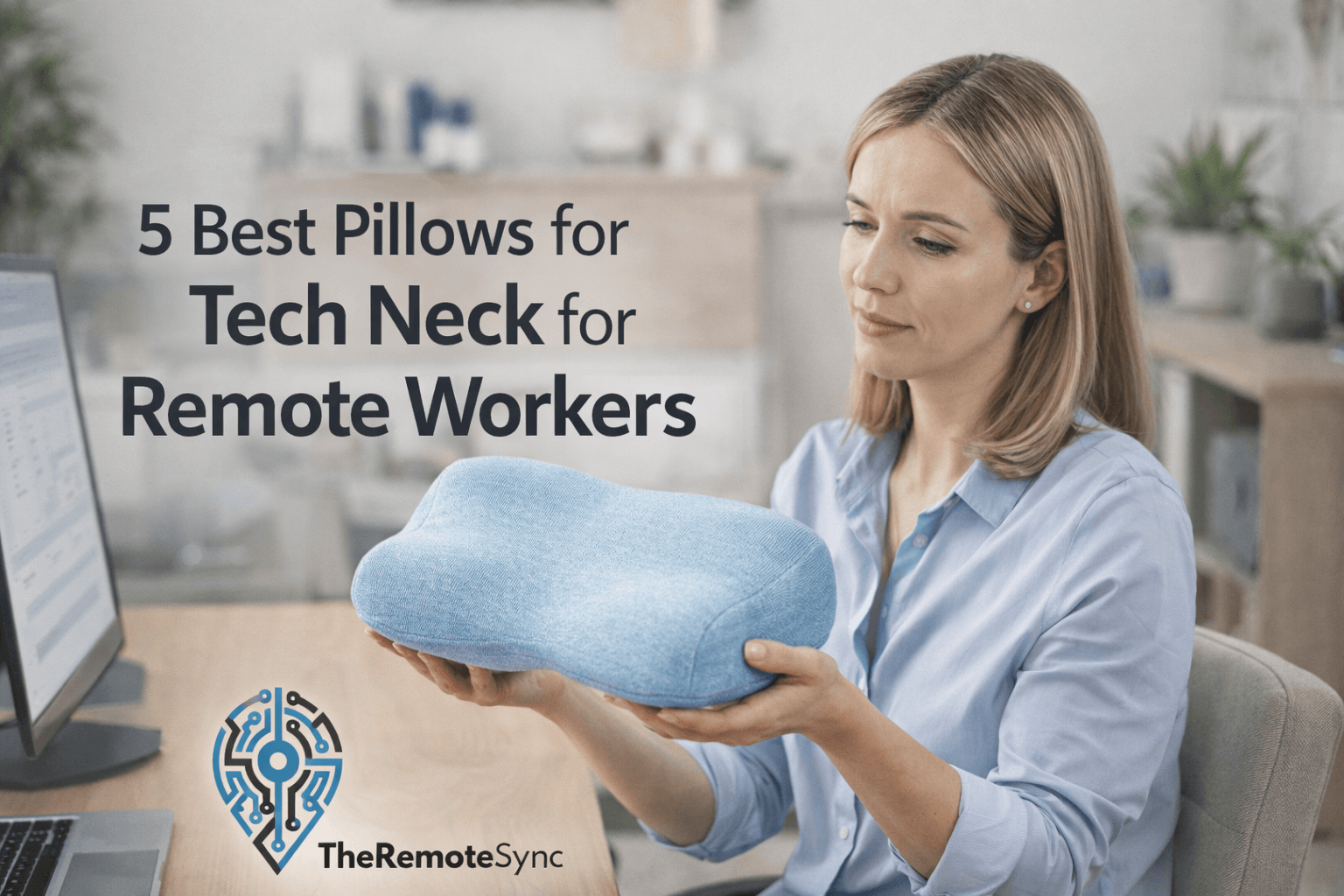
You finished your workday three hours ago, but your neck didn’t get the memo.
If you are reading this, you likely know the feeling: a dull, grinding ache at the base of your skull or a sharp tightness running down to your shoulders.
This is the hallmark of the remote worker’s lifestyle. We call it “remote work fatigue,” but the medical reality is often tech neck.
If your neck is compromised, your productivity crashes. While ergonomic chairs and standing desks get all the glory, your recovery time, specifically how you sleep, is just as critical.
Finding the best pillows for tech neck isn’t about buying the fluffiest option on the shelf. It is about finding a tool that corrects forward head posture while you recharge.
Below, we analyze the top 5 pillows that can help you reverse the daily damage of desk strain, keep your spine aligned, and get you back to 100% flow.
Understanding Tech Neck and Why Your Pillow Matters
Before we look at the hardware, let’s debug the problem. Tech neck is a repetitive stress injury caused by holding your head in a forward-leaning position for extended periods.
When you lean into your monitor or look down at your phone, you increase the gravitational pull on your cervical spine. A human head weighs about 10-12 pounds. Tilt it forward 45 degrees, and that weight on your neck muscles surges to nearly 50 pounds.
Tech Neck Symptoms to Watch For
If you ignore the early warnings, tech neck symptoms can escalate from annoyance to injury.
Common signs include:
- Chronic neck stiffness that doesn’t go away with stretching.
- Upper back tension, specifically between the shoulder blades.
- Frequent tension headaches or dizziness (yes, can tech neck cause dizziness? Absolutely).
- Tech neck lines or wrinkles appearing horizontally on the neck.
- The development of a tech neck hump at the base of the neck.
Can You Get Rid of Tech Neck?
The good news is that tech neck is not permanent if caught early.
Can tech neck be reversed? Yes. By combining the best sitting posture during the day with proper cervical support at night, you can restore your natural spinal curve.
This is where an orthopedic neck pillow comes in. Standard pillows often push your head too far forward (replicating the desk hunch) or let it sink too low. The right pillow fills the gap between your head and shoulders, allowing your muscles to fully relax and recover.
The 5 Best Pillows for Tech Neck
We selected these pillows based on their ability to support the cervical spine, their material quality, and their specific features for remote workers who spend 8+ hours at a desk.
1. DONAMA Cervical Pillow for Neck and Shoulder
Best For: Combination sleepers who need versatility.
Context: If you switch positions constantly during the night (side to back to side again), you usually lose support in the transition. The DONAMA solves this with a unique contour design that accommodates multiple sleeping styles without forcing you to wake up and fluff the pillow.
The Product: DONAMA Cervical Pillow for Neck and Shoulder
Why It Works: This pillow features a central cavity to cradle your head and raised “wings” or armrests.
For back sleepers, the cervical roll supports the natural curve of the neck. For side sleepers, the high sides keep the shoulder from collapsing, which is crucial for desk strain recovery.
It also comes with a cooling case, tackling the issue of heat retention common in memory foam.
Pros:
- Dual Height Options: You can use either side of the pillow depending on whether you need a high or low loft.
- Armrests: The wing design provides a place for your arms, reducing shoulder tension.
- Cooling: The ice silk pillowcase helps regulate temperature.
Cons:
- Adjustment Period: It can take 1-2 weeks for your neck to adjust to the rigid shape.
- Off-Gassing: Some users stated that there was a chemical smell for the first few days.
2. Derila Ergo Cervical Neck Pillow
Best For: Travelers and side sleepers who need stability.
Context: Remote work often means travel. Hotel pillows are notoriously bad for neck pain. The Derila offers a compact, consistent solution that corrects posture whether you are in your home office or a digital nomad hub.
The Product: Derila Ergo Cervical Neck Pillow
Why It Works: The Derila uses a “Butterfly” shape. The wings cradle your neck and head, preventing you from rolling into awkward angles that exacerbate tech neck wrinkles or pain.
It is smaller than a standard king pillow, making it denser and easier to manage if you move around.
The memory foam is firm, designed specifically to lock the neck into a neutral alignment.
Pros:
- Butterfly Shape: Excellent for keeping the neck stable and preventing rotation.
- Portability: Slightly smaller form factor makes it easier to pack than bulkier orthopedic pillows.
- Side Sleeper Support: The “nook” allows the shoulder to rest comfortably without hiking up toward the ear.
Cons:
- Size: Some users find it smaller than expected (check dimensions carefully).
- Firmness: It is quite firm; if you prefer a plush “cloud-like” feel, this is not for you.
3. EPABO Contour Memory Foam Pillow
Best For: Customizing your alignment.
Context: One size rarely fits all in ergonomics. A person with broad shoulders needs a higher pillow loft than someone with a petite frame. The EPABO addresses this with adjustable height, making it a safe bet if you are unsure exactly what size you need.
The Product: EPABO Contour Memory Foam Pillow
Why It Works: This is a classic contour memory foam pillow with a hidden feature: a removable piece of foam at the bottom. You can lower the height if it feels too aggressive.
This adaptability makes it one of the best pillows for neck and shoulder pain because you can dial in the fit until your spine is perfectly straight.
Pros:
- Adjustable Loft: You can remove the foam insert to lower the pillow height.
- Breathable: The case promotes airflow better than standard cotton.
- Proven Shape: The standard wave design is widely recommended by chiropractors for forward head posture correction.
Cons:
- Firmness: Even with the insert removed, the foam is high-density and firm.
- Shape: It does not have the “armrest” wings of the DONAMA or Elviros, so it is strictly for head/neck support.
4. Elviros Cervical Memory Foam Pillow
Best For: Shoulder pain relief and “Tech Hump” prevention.
Context: If your tech neck symptoms have migrated down into your upper back and shoulders, you need more than just a neck roll. You need shoulder contouring. The Elviros is designed to fit the curve of your shoulder girdle, reducing the strain on your trapezius muscles.
The Product: Elviros Cervical Memory Foam Pillows
Why It Works: This pillow looks almost like a spacecraft. It has a central divot for the head, a neck extension, and cutouts for your shoulders. This design ensures that when you sleep on your side, your shoulder doesn’t bunch up against your neck.
By keeping the shoulders depressed and relaxed, it helps prevent the formation of a tech neck hump.
Pros:
- Shoulder Contour: The cutouts allow your shoulders to fit snugly under the pillow, great for side sleepers.
- Arc Shape: The front of the pillow curves to support the neck without pressing against the jaw.
- Support: Very high level of mechanical support for the cervical spine.
Cons:
- Complex Shape: It forces you into a specific position. You cannot just “flop” onto it; you have to align yourself.
- Low Loft for Some: Very broad-shouldered individuals might still need extra height underneath it.
5. Tempur-Pedic TEMPUR-Ergo Neck Pillow
Best For: Durability and medical-grade support.
Context: Sometimes you want the industry standard. Tempur-Pedic pioneered the ergonomic sleeping pillow. If you want a product that won’t flatten out after six months of remote work, this is the investment piece.
The Product: Tempur-Pedic TEMPUR-Ergo Neck Pillow
Why It Works: Unlike generic memory foam, TEMPUR material was originally designed by NASA. It is extremely dense and adapts to your specific weight and temperature. The “wave” shape is simple but effective: a thick roll to support the neck and a thinner area for the head.
It provides consistent, unyielding support that is essential for chronic neck stiffness.
Pros:
- Durability: The material holds its shape for years, far longer than cheaper competitors.
- Sizing: Comes in Small, Medium, and Large sizes so you can pick the exact fit for your body frame.
- Material: The proprietary foam relieves pressure points better than standard poly-foam.
Cons:
- Price: It is significantly more expensive than the other options.
- Rigid: It is very firm. If you move around a lot, you might find the rigid shape unforgiving.
Beyond the Pillow: Fixing Your Remote Setup
Buying the best pillow for tech neck is a great first step, but it is not a magic cure. To truly optimize your health, you need to integrate active recovery into your day.
Quick Tech Neck Exercises
You don’t need a gym to fix your neck. Try these tech neck stretches right at your desk:
- Chin Tucks: Pull your chin straight back like you are making a “double chin.” Hold for 5 seconds. Repeat 10 times. This strengthens the deep cervical flexors.
- Corner Stretch: Stand in a corner with your arms on the walls at shoulder height. Lean in until you feel a stretch in your chest. This combats the hunched “keyboard posture.”
- Upper Trapezius Stretch: Gently tilt your ear toward your shoulder (don’t force it) to stretch the side of your neck.
FAQs: Recovery Time and Expectations
How long does it take to fix tech neck? It depends on severity. With consistent changes to your sleep and desk ergonomics, you can feel relief in tech neck symptoms within 2-4 weeks. However, correcting structural issues like a tech neck hump may take months of consistent posture work.
How long does a tech neck take to heal? Muscle strain can heal in days. Ligament creep (stretching of ligaments) takes weeks. The key is consistency. If you use an ergonomic pillow at night but slump over your laptop all day, you are taking one step forward and two steps back.
Can tech neck cause dizziness? Yes. Tight neck muscles can compress nerves and restrict blood flow, leading to tension headaches and dizziness. If you experience this often, consult a medical professional.
Conclusion
Your neck is the bridge between your brain and your body. As a remote worker, protecting that bridge is essential for your longevity and career performance.
Investing in the best pillow for tech neck is an investment in your daily energy levels. Whether you choose the customizable EPABO, the butterfly-shaped Derila, or the premium Tempur-Pedic, the goal is the same: proper alignment, deep rest, and a pain-free morning.
At TheRemoteSync, we believe high performance starts with high-quality recovery. Don’t let a bad night’s sleep derail your workflow.
Ready to upgrade your sleep setup? Check out the pillows above and start your recovery tonight.