
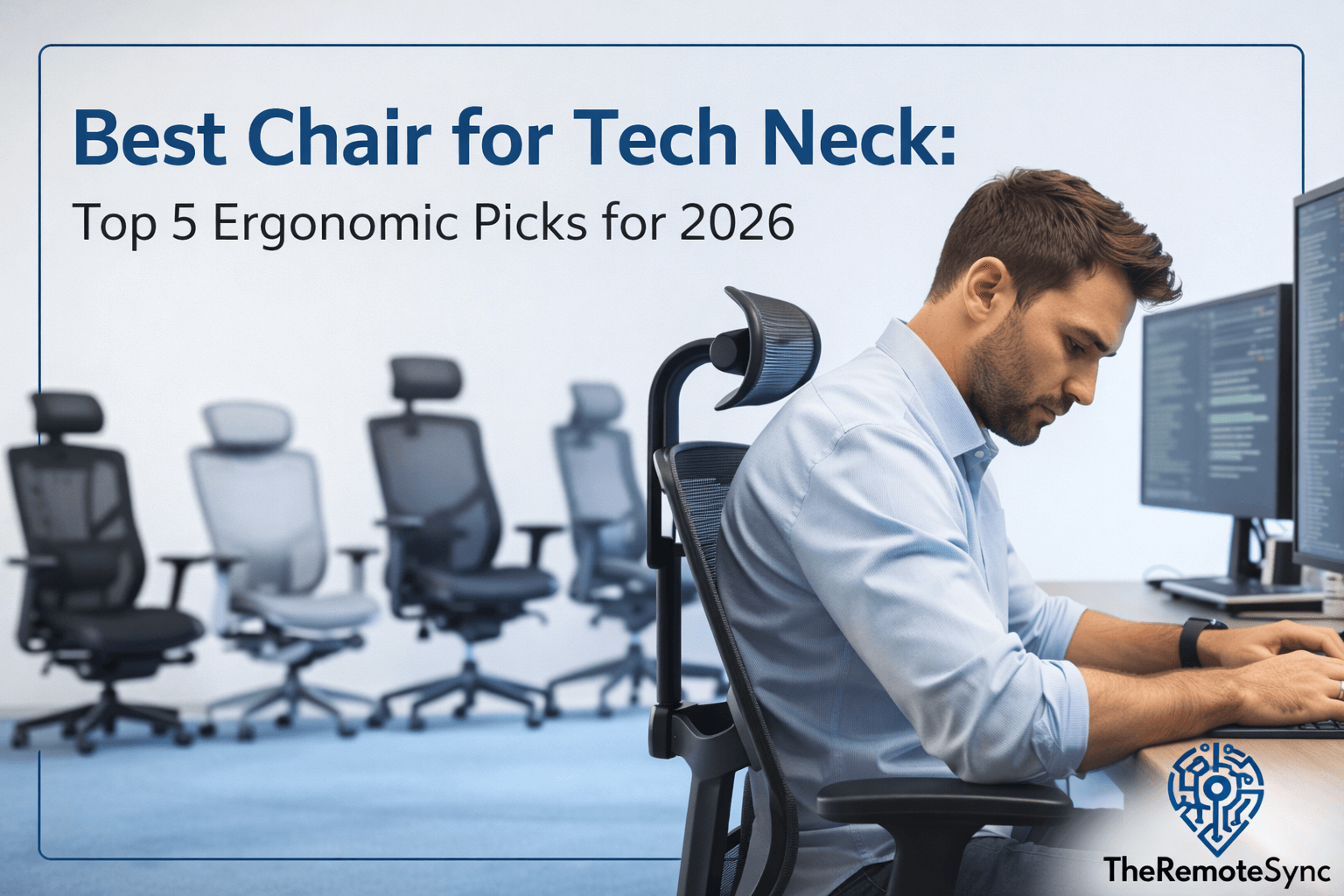
If you spend your day behind a screen, you likely know the dull ache at the base of your skull. This discomfort is often called tech neck. It happens when we lean forward to look at monitors or phones.
Over time, this habit leads to upper back and shoulder tension.
At TheRemoteSync, we focus on optimizing the remote lifestyle. We believe your workspace should support your health, not work against it.
A common question we get is: Is tech neck permanent? The good news is that can tech neck be reversed is a yes for most people. However, you need the right tools and habits.
The most important tool is a high-quality chair. This guide reviews the best chair for tech neck options available to help with forward head posture correction and long-term comfort.
Impact of Remote Working on Your Neck
Remote working has changed how we move.
In a traditional office, you might walk to a meeting or a colleague’s desk. At home, many remain in one spot for hours. This lack of movement is why remote working causes tech neck for so many professionals.
When you slouch, your head moves forward. This adds up to 60 pounds of extra weight to your neck muscles. This leads to the dreaded tech neck hump and even visible tech neck lines or tech neck wrinkles on the skin.
To fix this, you need an ergonomic setup for remote workers. This includes a chair that encourages cervical spine alignment and the best sitting posture.
Can You Get Rid of Tech Neck with a Chair?
You might wonder how to get rid of tech neck using just furniture. A chair alone is not a magic cure, but it is the foundation.
The right chair uses a synchro-tilt mechanism to keep your body moving. It also provides dynamic lumbar support to stop you from slouching.
If you combine a great chair with tech neck exercises and tech neck stretches, you will see results.
People often ask how long does it take to fix tech neck. While everybody is different, consistent use of ergonomic furniture and exercises for tech neck can show improvement in a few weeks.
Top 5 Chairs for Tech Neck Relief in 2026
We have analyzed the top performers for home office ergonomics 2026. Here are our top 5 chairs for tech neck based on build quality, user reviews, and ergonomic features.
1. Steelcase Gesture (with Headrest)
The Steelcase Gesture is often cited as the best chair for tech neck because it was designed around how we use modern tech. Most chairs assume you are just typing. The Gesture understands that you also use tablets and phones.
Description: This chair features highly flexible armrests and a contoured back. The 360-degree arms support your limbs in any position. The headrest is essential for tech neck relief as it adjusts to cradle your neck while you recline.
Build and Materials: It uses premium fabric and a reinforced polymer frame. The seat has air pockets to reduce pressure.
Price: This is a premium investment, typically costing over $1,400.
Pros:
- Incredible armrest mobility helps prevent shoulder strain.
- The headrest is one of the most adjustable on the market.
- It ships fully assembled.
Cons:
- Very expensive compared to mid-range options.
- The fabric can feel warm in the summer months.
2. Humanscale Freedom
If you want a chair that thinks for you, the Humanscale Freedom is the choice. It is a masterpiece of sedentary posture correction.
Description: The Freedom uses a weight-sensitive recline. There are no manual levers for tension. As you lean back, the adjustable headrest for neck pain automatically moves forward to keep your eyes on the screen.
Build and Materials: It features a die-cast aluminum frame and high-quality cushions. It looks minimalist and sleek.
Price: This is a high-end chair, usually priced around $1000.
Pros:
- An automatic headrest is perfect for forward head posture relief.
- Very easy to use with minimal adjustments needed.
- Extremely durable with a long warranty.
Cons:
- Some users feel like they are sliding out when fully reclined.
- Armrests move together, which limits individual side adjustments.
3. Herman Miller Aeron (with PostureFit SL)
The Herman Miller Aeron is an icon of remote work setups. While it doesn’t come with a headrest from the factory, its spine support is legendary.
Description: The PostureFit SL system supports the sacrum and the lumbar region simultaneously. This forces your spine into a healthy S-shape. This alignment is key for the best chair for tech neck and neck pain categories.
Build and Materials: It uses 8Z Pellicle mesh. This is a breathable mesh office chair that keeps you cool all day.
Price: Expect to pay between $1,200 and $1,800, depending on the size and features.
Pros:
- Unmatched breathability for long hours.
- PostureFit SL is excellent for lower and mid-back health.
- Retains its value well over time.
Cons:
- No native headrest (requires a third-party add-on for full tech neck support).
- The hard plastic frame can be uncomfortable if the chair is the wrong size.
4. Branch Ergonomic Chair Pro
For the remote worker on a budget, the Branch Ergonomic Pro offers the best value.
Description: This chair provides many premium features at a fraction of the cost. It includes a dedicated headrest and 5D armrests to help with the best chair for tech neck and shoulder pain.
Build and Materials: It uses a mix of polymer and mesh. The seat is a high-density foam that stays firm.
Price: This is a moderately priced option at around $500.
Pros:
- Very budget-friendly for the features provided.
- Strong tech neck relief via the adjustable headrest.
- Clean, modern design that fits any home office.
Cons:
- Requires assembly, which can be time-consuming.
- Materials feel slightly less “premium” than Steelcase or Herman Miller.
5. Hinomi H2 Pro
The Hinomi H2 Pro is a rising star for the best chair for long sitting hours. It is designed for maximum adjustability.
Description: It features 19 adjustment points. The most notable is the independent lumbar support and the wide headrest. It is a great contender for the best chair for neck and shoulder pain because you can fine-tune every angle.
Build and Materials: It uses an aluminum frame and breathable mesh. A unique feature is that it can fold in half for storage.
Price: Mid-range, usually around $600 to $700.
Pros:
- 4D armrests and a highly adjustable headrest.
- The folding design is great for small apartments.
- Pronounced lumbar support helps stop the slouch.
Cons:
- The lumbar support can feel too aggressive for some people.
- The mesh can feel very firm initially.
Essential Tech Neck Exercises and Stretches
Even with the best chair for neck pain at home, you must move. Here is a daily routine for forward head posture to use alongside your new chair.
- Effective Chin Tucks for Posture: Sit tall and look straight ahead. Gently tuck your chin back as if making a double chin. Hold for 5 seconds. Repeat 10 times.
- Chest Stretches: Stand in a doorway and place your arms on the frame. Lean forward to stretch your chest. This opens up the shoulders and reduces upper back and shoulder tension.
- Neck Tilts: Gently tilt your ear toward your shoulder. Hold and breathe. This provides immediate tech neck relief.
Creating an Ergonomic Desk Setup for Neck Pain
A chair is only half the battle. To truly understand how to get rid of tech neck, you must look at your whole desk.
- Monitor Height: Your screen should be at your eye level. Use a monitor arm or stand. This prevents you from looking down.
- Keyboard Position: Your elbows should be at a 90-degree angle. This is where 4D armrests help by supporting your weight.
- Pillow Choice: When you sleep, use the best pillow for tech neck. The best pillow for neck and shoulder pain will keep your spine neutral even while you rest.
Conclusion
Choosing the best chair for tech neck is an investment in your productivity and longevity. Remote work fatigue is often just physical pain in disguise.
By fixing your posture with a chair like the Steelcase Gesture or the Hinomi H2 Pro, you are taking the first step to reversing your tech neck.
Are you ready to upgrade your remote office? Visit our full guides at TheRemoteSync for more tips on work-from-home posture tips and the latest in remote wellness.