Most people shopping in this category make the same mistake: they compare specs on paper and assume the highest ANC rating wins. It does not work that way.
A headphone can claim -48dB of noise reduction and still let your neighbor’s conversation bleed through on a call. Another can have a modest spec sheet and genuinely disappear a loud HVAC system for four straight hours without fatiguing your ears.
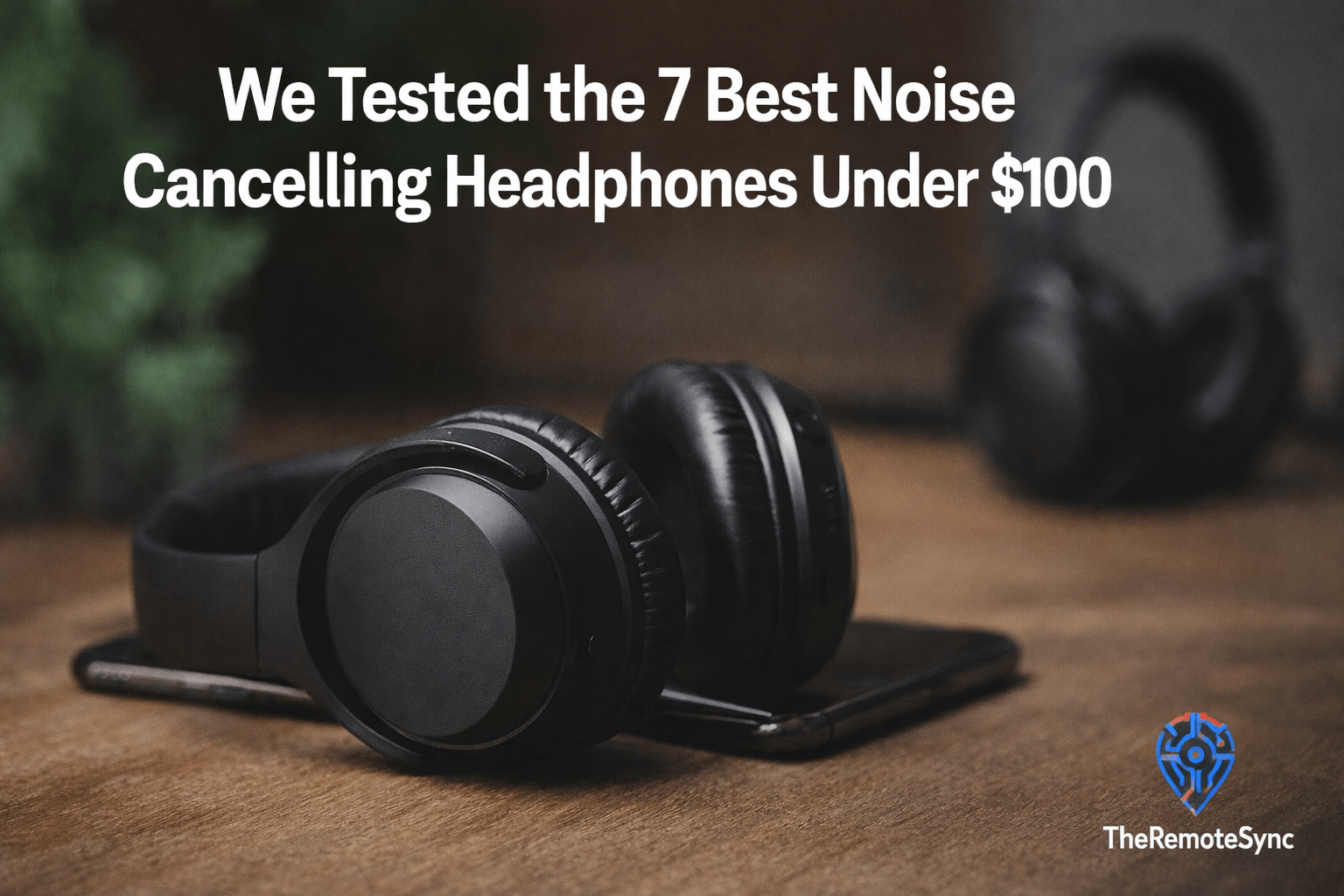
We tested seven pairs in real WFH conditions to find which ones actually hold up.
The short version: the gap between a $60 and a $350 ANC headphone has narrowed considerably. You are not getting the near-silence of a Sony WH-1000XM6. But for everyday home office use, several options on this list come close enough that the difference stops mattering.
Best Noise Cancelling Headphones Under $100 at a Glance
| Headphones | Best For | ANC Type | Battery (ANC On) | Price |
|---|---|---|---|---|
| Soundcore Q20i | Overall pick | 4-mic hybrid | 40-49 hours | Under $50 |
| Edifier W820NB Plus | Sound quality, Android/LDAC users | Hybrid, -35dB real-world | 31-33 hours | Under $100 |
| JLab Studio Pro ANC | Long hours, comfort | Adaptive hybrid, 4 modes | 43+ hours | ~$60-99 |
| Jabra Evolve2 30 SE | Professional calls, video meetings | Passive isolation, no ANC | Wired, no battery | Under $50 |
| Baseus Bowie MH1 | Newest specs, outdoor/hybrid work | 4-layer adaptive hybrid, -48dB | 55 hours | Under $60 |
| OneOdio Monitor 60 | Content creators, audio production | Passive only, no ANC/Bluetooth | Wired, no battery | Under $50 |
| Sony MDR-ZX310AP | Entry-level, quiet room only | None (passive isolation only) | Wired, no battery | $20-30 |
What Actually Matters in Budget ANC Headphones
Before the picks, a quick note on what to evaluate and what to ignore.
ANC type matters more than the dB number. Hybrid ANC (one microphone outside the ear cup, one inside) handles a wider frequency range than single-mic feedforward-only designs. Most quality options under $100 now use hybrid systems. Single-mic models are a step down, regardless of what their marketing says.
Battery life should be your second filter. Under $100, you should expect at least 30 hours with ANC on. Anything less is a red flag at this price point. The best models here push past 40 hours in real testing.
Microphone quality is the most common weak point. Many budget headphones sound fine for music but fall apart on calls because the mic picks up room echo, fan noise, or keyboard clatter. If video meetings are a daily part of your work, pay close attention to the mic notes in each section below.
Codec support matters only if you use Android. LDAC, which transmits up to 990kbps of audio data, is exclusive to Android. iPhone users default to AAC regardless. If you are on iOS, LDAC is not a meaningful differentiator for you.
The 7 Best Noise Cancelling Headphones Under $100
1. Soundcore by Anker Q20i — Best Overall
Best for: Remote workers who want the most ANC performance for the least money
The Soundcore Q20i is the easiest recommendation on this list. It is consistently the most-reviewed budget ANC headphone on Amazon, and its real-world performance justifies that popularity.
The Q20i uses a 4-microphone hybrid ANC system. In practice, it handles office fans, HVAC hum, road traffic, and low-frequency room noise well. High-pitched sounds like nearby conversations or mechanical keyboard clatter will still come through. That is true of almost everything under $100, so it is not a strike against the Q20i specifically.
Where this headphone genuinely separates itself is battery life. Anker claims 40 hours with ANC on; real-world tests consistently put it closer to 49 hours under normal listening conditions. A 5-minute fast charge adds 4 hours, which is useful when you forget to plug in overnight.
Multipoint Bluetooth (dual-device connection) is present and reliable. It stays connected to your laptop and phone simultaneously, and it switches automatically when a call comes in on either device. At this price, that feature alone would justify the purchase for many people.
One honest caveat: the default sound is bass-heavy. The Soundcore app gives you 22 EQ presets and manual adjustment, which fixes it. But you will want to spend five minutes in the app before your first long session.
The microphone works well in quiet home offices. Put yourself in a busy shared space or near an open window, and it degrades noticeably. This is a consistent flag from users across multiple review sources.
Quick specs:
- Bluetooth 5.0 | SBC, AAC
- 40mm drivers
- 40H (ANC on) / 60H (ANC off)
- Multipoint Bluetooth: Yes
- Weight: ~260g | Foldable: Yes
What works: Best ANC-to-price ratio under $50. Fast charge. Dual-device connection. App-based EQ.
What does not: Mic degrades in noisy environments. Default tuning needs EQ adjustment. Ear cups run slightly small for larger ears.
2. Edifier W820NB Plus — Best Sound Quality Under $100
Best for: Audio-conscious remote workers, LDAC Android users, anyone who cares how music sounds
The Edifier W820NB Plus is the headphone on this list that surprises people the most. It sounds more expensive than it is, and when you look at its spec sheet, the reason becomes clear.
It uses a 40mm titanium-coated composite diaphragm driver, certified for Hi-Res Audio and Hi-Res Wireless. It supports LDAC, which for Android users means wireless audio at up to 990kbps. That is roughly three times the detail ceiling of standard Bluetooth SBC. If you stream from Tidal or use FLAC files, this is a genuinely meaningful upgrade over every other option on this list.
ANC performance is competitive. Edifier advertises -43dB; real-world testing lands closer to -35dB at low frequencies, which is still enough to handle office noise, commute rumble, and HVAC hum without issue.
The call mic uses Deep Neural Network (DNN) noise cancellation, meaning it actively filters ambient noise from your voice rather than just hoping the hardware seal does the work. Among wireless options on this list, it has the cleanest call audio.
Battery hits around 31 to 33 hours with ANC on in tested conditions, not the headline 49-hour figure (that is ANC-off). A 10-minute fast charge gives you 7 hours of playback, which is excellent.
The main practical limitation is portability. It does not fold, and there is no carry case included. For a desk-first setup, that is not an issue. For anyone who commutes or travels regularly, factor that in.
Quick specs:
- Bluetooth 5.2 | LDAC, SBC
- 40mm titanium-coated driver | Hi-Res certified
- ~31–33H (ANC on) / 49H (ANC off)
- Multipoint: No
- Weight: ~238g | Foldable: No
What works: Sound quality is genuinely exceptional for this price. LDAC. DNN call mic. Fast charging.
What does not: Not foldable. No carry case. No multipoint Bluetooth. The Edifier Connect app interface is cluttered.
3. JLab Studio Pro ANC — Best for Long Hours and Comfort
Best for: Anyone sitting in headphones for 6 to 8 hours a day, back-to-back meetings, long focus blocks
At around $99 retail and frequently discounted to $60, the JLab Studio Pro ANC is JLab’s flagship over-ear. Its defining advantage is not ANC strength or audio quality. It is the combination of weight and cushioning.
At approximately 220g with Cloud Foam ear cushions that reviewers consistently describe as unusually soft, these are the easiest headphones on this list to forget you are wearing. If you have ever had a cheaper pair leave pressure marks or cause ear fatigue after a few hours, the difference here is noticeable.
The ANC system has four modes: High, Low, Off, and Be Aware. A standout feature is the adaptive behavior in High mode, where the system reads your environment and adjusts intensity on its own. This is useful for remote workers who move between a quiet study and a noisier common area during the day.
Battery is 43+ hours with ANC on in tested conditions. That figure holds up consistently across user reports.
One structural limitation worth flagging upfront: there is no companion app. EQ adjustment is limited to three on-device presets (JLab Signature, Balanced, Bass Boost), accessed by holding the volume buttons. If you want granular audio control, this is not the pick. If you want something that works without any setup, it is a genuine advantage.
The Be Aware transparency mode is functional but aggressive. It can drown out your music at normal listening volumes when activated. Most users leave it off during work sessions and only toggle it briefly when they need to hear something in the room.
Note: ear cups run slightly small. Users with larger ears report that the cups press against the ear rather than fully surrounding it. Worth testing in person before committing.
Quick specs:
- Bluetooth 5 | SBC, AAC
- 40mm neodymium drivers
- 43H+ (ANC on) / 45H+ (ANC off)
- Multipoint: No
- Weight: ~220g | Foldable: Yes | Includes travel bag + USB-C + 3.5mm
What works: Best comfort-to-weight ratio on the list. Strong battery. No app needed. Adaptive ANC.
What does not: No app or granular EQ. Transparency mode can overwhelm audio. Ear cups run small.
4. Jabra Evolve2 30 SE — Best for Professional Calls and Video Meetings
Best for: Professionals whose entire workday runs on Zoom, Teams, or Google Meet
This one is different from every other pick here. The Jabra Evolve2 30 SE is a wired professional headset, not a wireless consumer headphone. There is no ANC in the traditional sense, no Bluetooth, and no battery.
What it offers instead is passive noise isolation engineered specifically for call clarity. The angled ear cup design with high-density memory foam cancels 48% more ambient noise than a standard on-ear headset, without any electronics involved.
The dual-microphone boom arm is the headline reason to buy this. One mic captures your voice directly; the second cancels background noise in real time. Jabra designed this to meet Microsoft Open Office requirements, which is a professional-grade standard for call audio. In a shared home or open-plan office, the difference between this and a consumer wireless headset on a call is audible to the other people you are speaking with.
It is Microsoft Teams certified and works plug-and-play with Zoom, Google Meet, Cisco, Avaya, and Mitel. No driver installation, no pairing sequence.
The integrated busylight on the right ear cup activates automatically during calls and can be toggled manually as a Do Not Disturb signal. If you have family members or housemates who walk into your workspace during meetings, this is a practical feature that consumer headphones do not offer.
At ~125g with the cable, it is one of the lightest options on this list and produces no neck or head fatigue over long sessions.
The limitation is obvious and intentional: it is tethered to a cable. If you need mobility while on calls, or you use headphones primarily for focus listening rather than meetings, look elsewhere on this list.
Quick specs:
- Wired: USB-A + USB-C (included)
- 28mm professional-grade drivers
- 2-mic boom arm system
- Passive isolation: -48% vs. standard headsets
- Weight: ~125g | Teams certified: Yes | Busylight: Yes
What works: Best call clarity on the list. No battery dependency. Wired reliability. Busylight. Extremely light.
What does not: Wired only. No ANC. Music quality is functional, not impressive. No EQ.
5. Baseus Bowie MH1 — Best Feature Set for the Price
Best for: Tech-forward buyers who want modern specs and are comfortable with a newer brand
The Baseus Bowie MH1 reads like a spec sheet from a $150 headphone. Bluetooth 6.0, LDAC, -48dB adaptive ANC, a 5-mic AI call system, and an 80-hour battery claim at under $60 are features you would not expect to see in this price bracket.
The ANC uses a 4-layer hybrid system that Baseus says processes environmental data 380,000 times per second and adjusts in real time. The -48dB noise reduction figure is the highest spec claim on this list. Independent testing confirms strong low-frequency performance, though as with any budget headphone, peak lab figures do not reflect every real-world environment.
The 5-mic AI call system is the most sophisticated call mic arrangement here. It includes wind noise reduction, which makes it more versatile than anything else on the list for outdoor or hybrid workers who sometimes take calls outside.
Battery life of 80 hours (ANC off) and 55 hours (ANC on) is genuinely extraordinary at this price. Bluetooth 6.0 is the most future-proof connection on this list.
The important caveat: the Bowie MH1 is a newer product. Long-term durability is not yet established through the volume of user reports that older models have. The specs are impressive, and early feedback is positive, but it does not have the track record of the Soundcore Q20i or Edifier W820NB Plus.
If that uncertainty does not bother you, and you want the highest specifications available under $60, the MH1 is the pick.
Quick specs:
- Bluetooth 6.0 | LDAC, SBC, AAC
- Adaptive hybrid ANC up to -48dB
- 80H (ANC off) / 55H (ANC on)
- 5-mic AI system | Hi-Res certified
- Weight: ~245g | Foldable: Yes | Includes carry case
What works: Highest ANC spec and longest battery on the list. Bluetooth 6.0. Best mic system for outdoor use.
What does not: Limited long-term review data. Adaptive ANC can feel aggressive in very quiet environments. The app has a learning curve.
6. OneOdio Monitor 60 — Best for Content Creators and Audio Production
Best for: Podcasters, video editors, and home studio producers who also work remotely
The OneOdio Monitor 60 is not an ANC headphone and is not built for commuting or video calls. It earns its place on this list because it serves a specific type of remote worker that the other six options do not.
If you create content, produce audio, record a podcast, or edit video alongside your regular remote work, most consumer headphones will mislead you. They apply sound coloring that makes music enjoyable but inaccurate. The Monitor 60 is tuned for accuracy.
The 50mm neodymium driver covers 20Hz to 40kHz and is Hi-Res Audio certified. The closed-back sealed design delivers passive isolation that keeps external sound out without any electronic processing. At 38 ohms impedance, it runs directly from a laptop, phone, or audio interface without an external amplifier.
The build is practical for studio use: 180° rotating ear cups for single-ear monitoring, three cables included (1.2m with inline mic, 3m straight, 3m coiled with 6.3mm adapter), and a soft carry pouch. The spring steel headband with PU leather covering is built for repeated daily use.
The sound signature has a slight V-shape with bass emphasis. Multiple reviewers note it responds cleanly to EQ, reaching a near-flat reference curve with modest adjustment. The default tuning is significantly more balanced than OneOdio’s earlier models.
Extended sessions at high volume can produce treble fatigue. Dialing back the high frequencies in your EQ addresses it.
For everyday remote workers with no audio production needs, this is not the right pick. But if audio or video editing is part of your day, no other option on this list serves that use case as well.
Quick specs:
- 50mm neodymium dynamic driver
- 20Hz–40kHz | 38 ohms | 110dB
- 3 cables included (3.5mm + 6.3mm adapter)
- 180° rotating ear cups | Hi-Res certified
- Foldable: Yes | Carry pouch: Yes
What works: Largest driver on the list. Accurate passive isolation. Versatile cable set. Strong value for content creation.
What does not: No ANC, no Bluetooth, no call mic system. Not for casual commuting or video meetings.
7. Sony MDR-ZX310AP — Best Entry-Level Pick
Best for: Budget-first buyers, students, anyone who needs a reliable secondary pair for a quiet home desk
The Sony MDR-ZX310AP is the most affordable pick on this list, typically around $20 to $30. There is no ANC, no Bluetooth, and no companion app.
What it does have is Sony’s audio tuning, which at any price point carries weight. The 30mm neodymium drivers cover 10Hz to 24kHz with a warm, balanced sound that reviewers consistently describe as fatigue-free over extended listening. If you have heard other Sony consumer headphones in this range, the house sound is consistent.
Passive isolation is modest. The on-ear design with padded swivel ear cups creates a reasonable seal for quiet environments, meaning a dedicated home desk in a low-noise room. This is not the pick for open offices or shared spaces.
The inline mic and multi-function button handle calls and music control cleanly. The gold-plated L-shaped plug provides a stable connection. At 127g, it is the lightest pair on this list, which makes it an easy secondary option to leave at a second desk or pack for travel.
The main durability flag: the ear pads are plastic-backed and users report faster wear than the foam pads on more premium options. Worth keeping in mind if you are planning on using it daily for years.
At $20 to $30, this is the right pick if your budget does not stretch to $50, or if you need a reliable backup pair.
Quick specs:
- 30mm ferrite/neodymium driver
- 10Hz–24kHz | 3.5mm wired
- Inline mic + multifunction button
- Weight: ~127g | Foldable: Yes
What works: Reliable Sony audio at the lowest price. Lightweight. L-shaped plug for durability.
What does not: No ANC. Limited passive isolation. Ear pads wear faster than average. No Bluetooth.
Do Cheap Noise Cancelling Headphones Actually Work?
Yes, with honest expectations.
Budget ANC handles constant low-frequency noise well: HVAC systems, engine hum, fan noise, the low rumble of a busy street outside. These are also the most common productivity disruptors for remote workers at home.
It struggles with sudden mid-to-high frequency sounds: sharp voices, typing on a mechanical keyboard nearby, or a dog barking. That gap is real compared to premium models, but it narrows considerably with hybrid ANC systems, which most of the options above use.
Research on open-plan office noise consistently shows that unpredictable, intermittent sounds are more disruptive to concentration than constant background noise. Budget ANC addresses the constant layer effectively. The intermittent layer is harder for any headphone to eliminate.
For most remote workers, that is still a meaningful improvement.
Best Pick Under $50
If your budget caps at $50, two options stand out.
The Soundcore Q20i is the default recommendation. Hybrid ANC, 40-hour ANC-on battery, dual-device Bluetooth, and app-based EQ, consistently available for under $50. It is the most tested and most recommended budget ANC headphone in this category.
The Baseus Bowie MH1 is worth considering if you want more modern specs (Bluetooth 6.0, -48dB ANC, 80-hour battery) and can accept that it is a newer product with less long-term review history.
A Few Practical Notes Before You Buy
Prices fluctuate. Budget headphones on Amazon can shift $20 to $35 in either direction week to week. Set a price alert before you buy.
Test in your actual workspace. ANC performance varies by environment. A headphone that handles your colleague’s apartment layout well may perform differently than it does in your home. Use the Amazon return window as a trial period.
LDAC is Android-only. If you are on an iPhone, the LDAC advantage on the Edifier and Baseus models does not apply. Both still sound good on AAC, but the codec upgrade is not a reason to pick them over alternatives for iOS users.
App vs. no-app. Suppose you want granular EQ control: Q20i, Edifier W820NB Plus, or Baseus MH1. If you prefer plug-and-play with no app setup: JLab Studio Pro or Jabra Evolve2 30 SE.
Pairing your headphones with the right desk setup also matters. If you are still building out your workspace, our WFH setup guide covers the full picture, and our best headphones for remote work guide covers the broader category if you are open to spending more.
Frequently Asked Questions
Do cheap noise cancelling headphones actually work?
Yes, with realistic expectations. Budget ANC handles constant low-frequency noise well, HVAC systems, fan noise, street rumble, which are also the most common disruptors for remote workers at home. It struggles more with sudden, sharp sounds like voices or keyboard clatter, but that gap has narrowed considerably now that most sub-$100 options use hybrid ANC systems.
What is the best noise cancelling headphone under $100 overall?
The Soundcore Q20i is the top pick, with the best ANC-to-price ratio on the list, a 40-hour battery with ANC on (often closer to 49 hours in real testing), dual-device Bluetooth, and app-based EQ. It’s consistently the most-reviewed budget ANC headphone on Amazon, and the real-world performance backs that up.
What is the best noise cancelling headphone for video calls and meetings?
The Jabra Evolve2 30 SE, a wired professional headset rather than a wireless consumer headphone. Its dual-microphone boom arm and passive isolation are engineered specifically for call clarity, and it’s Microsoft Teams certified. If your workday is mostly meetings, this beats wireless convenience on audio quality alone.
Do I need a companion app for good sound on a budget ANC headphone?
Not necessarily, but it depends on the model. The Soundcore Q20i, Edifier W820NB Plus, and Baseus Bowie MH1 all rely on app-based EQ to sound their best out of the box. The JLab Studio Pro ANC and Jabra Evolve2 30 SE work well with no app at all, so if you’d rather skip setup entirely, those are the better picks.
Final Verdict
For most remote workers: Soundcore Q20i. Best ANC-to-cost ratio, strong battery, multipoint Bluetooth. Start here.
For sound quality: Edifier W820NB Plus. The audio gap between this and headphones at $200+ is smaller than it should be at this price.
For daily call-heavy work: Jabra Evolve2 30 SE. If your job is meetings, wired call clarity beats wireless convenience.
For content creators: OneOdio Monitor 60. The only option on this list that serves a production workflow.
For under $50: Soundcore Q20i first. Baseus Bowie MH1 if you want the newest hardware and can tolerate the shorter review track record.
A quiet workspace is a legitimate productivity decision. In 2026, you can make it for under $100.