Modern remote work often means staring at a screen for 8 to 10 hours a day.
This lifestyle can lead to digital eye strain and Computer Vision Syndrome (CVS).
If you find yourself dealing with digital eye strain headaches or blurred vision computer screen issues by 3:00 PM, your monitor settings are likely to blame.
Adjusting your display is the fastest way to protect your vision.
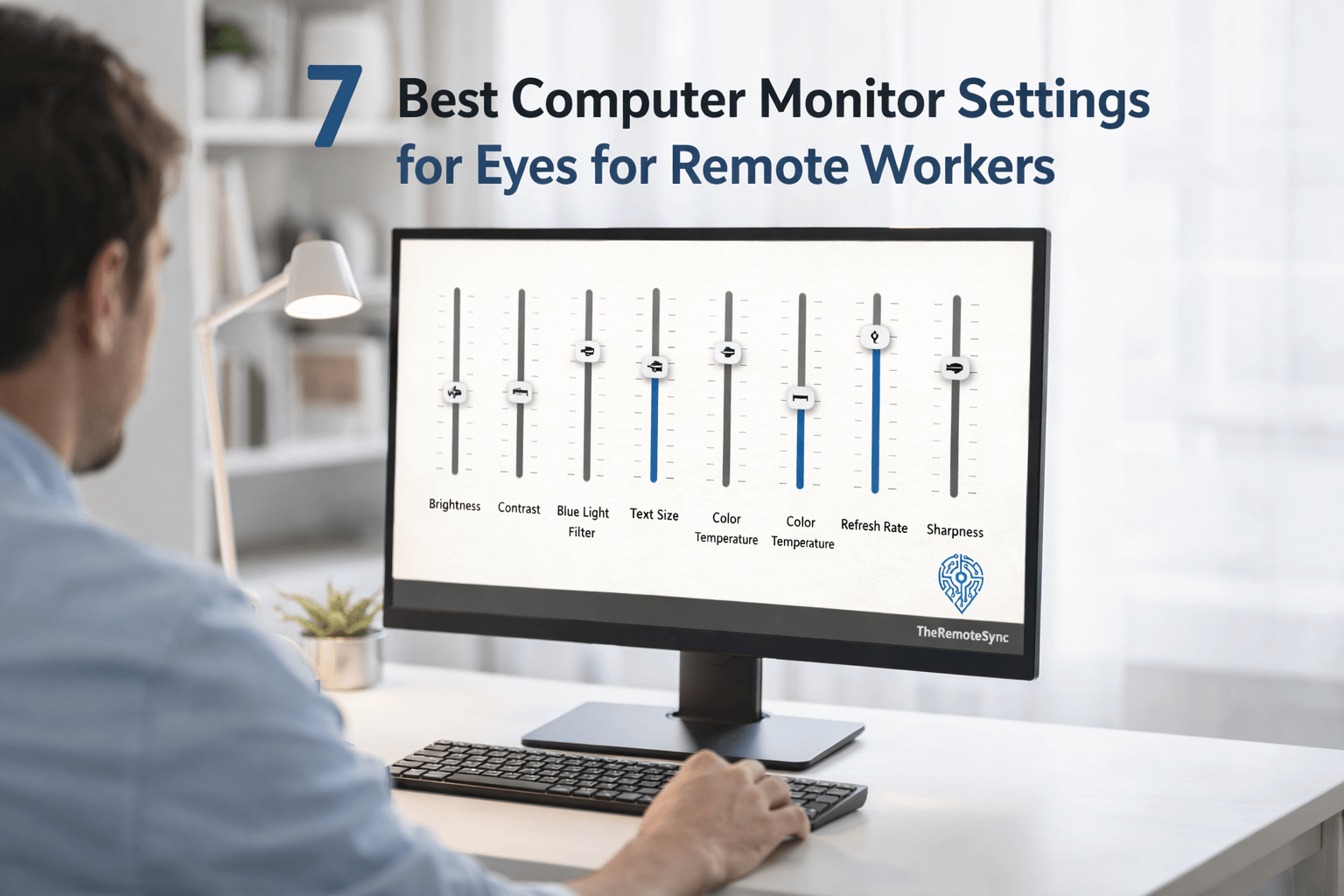
This guide covers the best computer monitor settings for eyes to help you stay productive without pain.
1. Match Your Brightness to Ambient Lighting
One of the main causes of eye strain is a screen that is much brighter or dimmer than the room.
If your monitor glows like a lamp in a dark room, your pupils must constrict and dilate constantly. This causes focus fatigue.
- The Goal: Your screen should look like a piece of paper in the room, not a light source.
- Optimal screen brightness for eyes: For most home offices, a brightness level between 100 nits (brightness) and 150 nits is ideal.
- How to check: Hold a white piece of paper next to your monitor. If the screen looks much brighter than the paper, turn the brightness down.
2. Adjust Your Color Temperature and Blue Light Filter
Color temperature refers to the “warmth” or “coolness” of the light.
High-energy blue light is great for staying alert during the day.
However, too much of it leads to dry eyes from computer use and keeps you awake at night.
- Daytime settings: Use a neutral temperature around 6,500K. This mimics natural sunlight.
- Evening settings: Switch to a warmer, yellowish tone around 3,400K or lower.
- Best tools: Use f.lux, Windows Night Light, or macOS Night Shift to automate this. These tools act as a digital blue light filter that changes based on the sun’s position.
3. Set the Correct Contrast Ratio
The contrast ratio is the difference between the whitest whites and the blackest blacks. If the contrast is too low, your eyes struggle to tell letters apart from the background.
- Ideal setting: Keep your contrast ratio between 60% and 70%.
- Text clarity: Ensure you have dark text on a light background for long reading sessions. This provides the best legibility and reduces the effort your brain needs to process words.
4. Increase Refresh Rate (Hz) for Smooth Motion
A low refresh rate (Hz) can cause a subtle flicker. You might not see the flicker, but your brain does. This is a common trigger for digital eye strain headaches.
- Standard screens: Most office monitors default to 60Hz.
- Better options: If your monitor supports it, move to 75Hz, 120Hz, or higher. A higher refresh rate makes scrolling and mouse movement smoother, which is much easier on the eyes.
5. Use Native Resolution and Display Scaling
Running a monitor at a resolution it wasn’t built for makes images blurry. This blurred vision computer screen effect forces your eyes to work harder to “clear up” the image.
- Native resolution: Always set your PC to the “Recommended” resolution in your display settings.
- Display scaling: If the text is too small, do not lower the resolution. Instead, use display scaling (zoom). Setting this to 125% or 150% makes everything larger and easier to read while keeping it sharp.
6. Ergonomic Positioning and Monitor Distance
The best computer monitor settings won’t help if your screen is too close. How far should monitor be from eyes? You should follow the “arm’s length” rule.
- Distance: Keep the screen between 20 and 28 inches away.
- Height: The top of your screen should be at or slightly below your eye level. This creates a 10 to 15-degree downward gaze, which helps prevent dry eyes from computer use because your eyelids cover more of your eye.
7. Is Dark Mode Better for Your Eyes?
Many people ask, is dark mode better for your eyes? Or does dark mode help eye strain? The answer depends on your ambient lighting.
- In dark rooms: Yes, dark mode vs. light mode favors dark mode. It reduces the total light hitting your eyes.
- In bright rooms: No. In a bright office, dark mode can cause “halation.” This is when white text seems to “bleed” into the black background, making it harder to read.
- The Verdict: Use light mode during the day and dark mode at night.
Beyond Settings: Habits for Remote Workers
Even with the best computer monitor for eyes, you still need to rest.
Remote work often removes the natural breaks we get in a physical office.
The 20-20-20 Rule for Eyes
To fight Computer Vision Syndrome (CVS), follow the 20-20-20 rule for eyes:
- Every 20 minutes.
- Look at something 20 feet away.
- For 20 seconds.
This relaxes the tiny muscles inside your eyes that get “locked” while looking at a close screen.
Dry Eye Relief
We blink 60% less when looking at a monitor.
To get dry eye relief, try to blink more often and keep ergonomic desk lighting in your room.
Avoid having a bright window directly behind or in front of your screen to reduce screen glare.
Frequently Asked Questions
What are the best monitor settings for eyes?
Match your brightness to the room so your screen looks like a piece of paper rather than a light source, aim for 100 to 150 nits in most home offices. Set color temperature to a neutral 6,500K during the day and warmer around 3,400K in the evening, keep contrast between 60% and 70%, and run your display at native resolution with scaling turned up rather than resolution turned down if text feels small.
Is 60Hz or 120Hz better for eyes?
120Hz is better. A low refresh rate like 60Hz can cause a subtle flicker that your eyes don’t consciously register but still respond to, and that flicker is a common trigger for eye strain headaches. Moving to 75Hz, 120Hz, or higher makes scrolling and cursor movement smoother, which reduces the effort your eyes spend processing motion.
Does 240Hz reduce eye strain?
It can help further, but the gains taper off past 120Hz for most people. The biggest jump in comfort comes from moving off a standard 60Hz screen to something smoother like 120Hz. Beyond that, 240Hz is more valuable for fast motion tasks like gaming than it is a meaningful additional fix for everyday eye strain.
Is IPS or OLED better for eyes?
Both are strong choices, and the better pick depends on your setup. IPS panels offer excellent contrast and color accuracy for all-day use at a desktop scale. OLED panels naturally emit less blue light and offer even higher contrast, making them a great option for secondary or portable displays, though they’re less common as large primary desktop monitors.
How do you reduce eye fatigue from a computer screen?
Layer your settings with your habits: match screen brightness to ambient light, use a neutral color temperature during the day, and keep the screen 20 to 28 inches away with the top at or slightly below eye level. On top of the setup, follow the 20-20-20 rule (every 20 minutes, look at something 20 feet away for 20 seconds) and blink consciously more often, since blink rate drops significantly during screen use.
Conclusion
Your eyes are your most important tool as a remote worker.
By adjusting your optimal screen brightness for eyes, using a blue light filter, and following the 20 20 20 rule, you can eliminate focus fatigue and protect your long-term health.
How can I protect my eyes if I work on computer for long hours?
Start by checking your settings today. Small changes in contrast ratio and color temperature make a massive difference over a 40-hour work week.
Ready to upgrade your home office for better health?
Read our guide on the best computer monitor for eye strain!